Two Principles of Modern Decorative Art: Crane’s Warning Against Fashionable Novelty
Walter Crane’s modern decorative art theory, set out after his visit to the Turin exhibition of 1902, remains one of the clearest Arts and CraftsRead More →
January 31, 2025

Walter Crane’s modern decorative art theory, set out after his visit to the Turin exhibition of 1902, remains one of the clearest Arts and Crafts critiques of novelty for novelty’s sake. Writing on “Modern Decorative Art at Turin,” Crane did not merely review an international exhibition. He used Turin as a testing ground for a larger argument: modern decoration must grow from material, function, construction, and environment. When it instead follows fashion, it loses both artistic integrity and practical sense.

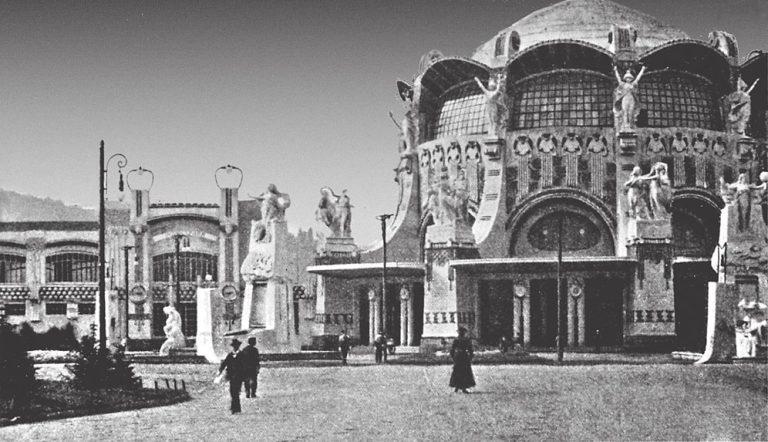
The First International Exhibition of Modern Decorative Art was held in Turin from May to November 1902, in temporary buildings in the Parco di Valentino. Its stated emphasis on the modern house, the complete modern room, and the relationship between architecture and decorative arts made it an unusually concentrated stage for debates about Art Nouveau, national identity, craft, and the future of applied art.
Crane approached the Turin exhibition with sympathy and caution. He recognised the vitality of the so-called “new art,” whether labelled Arte Moderna, l’Art Nouveau, or another national variation. Yet he resisted treating modernity as a style to be copied. For him, decorative art was not modern because it used sinuous lines, strange plant forms, or unfamiliar materials. It became modern when it responded honestly to present conditions.
This distinction matters. Around 1900, designers across Europe were seeking alternatives to historical revivalism. Gothic, Renaissance, Rococo, and classical vocabularies had been repeated for generations, often with little relationship to modern life. Art Nouveau promised renewal through organic line, abstracted nature, and unity between architecture and furnishings. However, Crane saw that even reform movements could become formulaic. A new style could harden into a new convention as quickly as an old one.
That concern gives his essay its lasting authority. Crane did not reject ornament. On the contrary, as an illustrator, socialist, designer, and major figure associated with the Arts and Crafts movement, he valued decoration deeply. What he opposed was decoration detached from purpose. In this sense, his Turin essay belongs to a longer design history in which ornament is not abolished but disciplined by use, workmanship, and place.
Crane’s first principle of modern decorative art was one of health, growth, and development. He associated good design with organic evolution, not arbitrary invention. The form of a chair, cabinet, textile, or room should arise from the object’s nature and circumstances. Its ornament should clarify, enrich, or intensify that nature rather than conceal it.
He described this healthy direction as one of restraint, simplicity of construction, and respect for the limits of material. This was not a plea for plainness in the narrow sense. Rather, Crane argued that ornament must remain answerable to construction. A decorated object should still reveal what it is, how it is made, and how it is meant to function. Decoration that contradicts these conditions becomes theatrical surface.
In practical terms, Crane asked designers to consider the behaviour of materials. Wood, metal, glass, textile, and ceramic each offer different structural possibilities and visual effects. A design that exploits these qualities intelligently becomes richer than one that merely imposes a fashionable motif. This principle places Crane close to the material conscience of decorative arts reform: beauty arises through right handling, not decorative excess.
Crane’s plant analogy is central to this argument. He compared natural growth with artificial stimulus. A plant forced into exaggerated development may become strange, attenuated, or grotesque. Likewise, modern design pushed by fashion may appear novel while losing structural health. The lesson is not that designers should imitate plants literally. It is that design should develop from inner necessity, as natural growth does.
Crane’s second principle was a warning. Modern decorative art could also move in a less healthy direction: it could “follow a fashion whithersoever it may lead.” In this case, designers adopt forms and lines for their own sake. They repeat mannerisms before those forms have been tested by material, construction, or use. The result may look modern, but it remains superficial.
This critique was aimed at more than individual bad taste. Crane saw a broader danger in exhibitions themselves. International displays allowed designers to compare, borrow, and learn from one another. Yet they also encouraged imitation. The imitator might copy another nation’s formal language without understanding the conditions that produced it. A curve, a stem, a flattened panel, or an unusual join could be detached from its context and reapplied as a visual sign of novelty.
For Crane, this was the failure of fashion. It mistakes appearance for principle. It treats design as a vocabulary of effects rather than a discipline of relationships. Such work may display technical skill, expensive materials, or daring surfaces, but it often lacks harmony. It asks us to admire ingenuity rather than understand purpose.
Crane’s most searching question was whether decoration helps “the expression of the object so adorned.” That question remains a concise test for applied art. If ornament strengthens the object’s role, it belongs. If it confuses or weakens that role, it becomes an intrusion.
His example of inlaid wood is especially revealing. Crane admired craftsmanship, but he objected when wood was used as if it were paint. Pictorial marquetry could demonstrate virtuosity, yet it might fail as furniture decoration if it ignored the flat, structural, and tactile character of wood. The problem was not skill; it was misplaced skill. A panel designed as decorative pattern could serve the room and object more effectively than an illusionistic picture inserted into a cabinet or wall surface.
This distinction between pictorial art and decorative pattern shows Crane’s precision as a critic. Painting may create atmosphere, depth, and illusion. Decorative art, however, usually works through surface, rhythm, proportion, repetition, and relation to use. A textile, cabinet, screen, or room panel must respect its setting. Its beauty unfolds through contact with architecture, furniture, light, and daily life.
Here Crane’s thought connects to later modernist concerns, even where later designers rejected ornament more aggressively. The Bauhaus, for example, would place strong emphasis on material experience, workshop training, industry, and the relationship between design and mass production. Alfred H. Barr’s 1938 MoMA preface to Bauhaus 1919–1928 described Bauhaus principles that included manual experience of materials and rational design in terms of technics and materials as a first step toward a modern sense of beauty.
Crane also understood modern decorative art as an international language with local dialects. At Turin, he observed that national sections differed in temperament, materials, and habits. He did not want each nation to retreat into isolation. However, he believed that genuine design must absorb climate, custom, available materials, and ways of living.
This is why the Turin exhibition was both exciting and dangerous. The Scottish Section, designed by Charles Rennie Mackintosh, was one of the most discussed interiors at the exhibition. The University of Glasgow catalogue notes that it formed a suite of three rooms and that one room included the celebrated “Rose Boudoir” by Mackintosh and Margaret Macdonald. {Such room settings demonstrated how a modern decorative language could be spatial, atmospheric, and integrated rather than merely ornamental.
Yet Crane’s warning still applies. A designer could not become Scottish, Belgian, Austrian, or Italian simply by copying surface features. Modern decorative art required assimilation. Borrowed forms had to pass through material, purpose, and environment before they became legitimate. Without that process, international exchange became decorative tourism.
Crane’s argument remains relevant because design culture still rewards novelty. Contemporary objects often compete for attention through unusual silhouettes, dramatic materials, digital effects, or symbolic gestures. Some innovations genuinely extend function or improve experience. Others merely signal difference. Crane gives us a way to distinguish between them.
His first principle asks whether a design has grown from its conditions. Does the material make sense? Does the construction serve the purpose? Does the ornament clarify the object’s use or setting? Does the form belong to the environment in which it will live? These questions apply as much to a contemporary chair, lamp, interface, or textile as they did to the rooms and furnishings at Turin.
His second principle warns against design that performs modernity without earning it. Fashionable novelty can be seductive because it seems progressive. Yet a form that has not been assimilated into use may age quickly. By contrast, design rooted in material intelligence and functional clarity can remain fresh long after its style has ceased to be new.
Ultimately, Walter Crane’s modern decorative art theory is ethical as well as aesthetic. It asks designers to be responsible to objects, users, materials, and environments. It rejects both empty historicism and empty novelty. It does not deny imagination; rather, it insists that imagination must work through craft, structure, and purpose.
That is why Crane’s Turin essay remains more than an exhibition review. It is a compact theory of applied art at a moment when Europe was searching for a modern decorative language. His two principles still offer a useful standard: one path leads toward organic development, restraint, and harmony; the other leads toward mannerism, display, and fashion. For Crane, the future of decorative art depended on choosing the first path without losing vitality, beauty, or invention.
Crane, W. (1902). “Modern Decorative Art at Turin: General Impressions.” The Magazine of Art, 25, 488–493. :
The University of Glasgow’s Mackintosh Architecture catalogue identifies Crane’s essay in its bibliography and documents the Turin exhibition’s dates, context, and Scottish Section.
Walter Crane’s modern decorative art theory, set out after his visit to the Turin exhibition of 1902, remains one of the clearest Arts and CraftsRead More →
Supermannerism, a contemporary design critique, embraces ornamental complexity, historical references, and contradiction, challenging Modernist principles while celebrating playful and expressive aesthetics.Read More →
Introduction Andrew Jackson Downing stands as a pivotal figure in the formation of nineteenth-century American design culture. As a landscape architect, horticulturalist, and influential author,Read More →
Nancy Vincent McClelland (1877–1959) was an American interior designer, historian, and tastemaker whose work shaped the revival of historic interiors in the United States. SheRead More →
James Powell & Sons was a leading British glassware manufacturer active from the late nineteenth century into the early twentieth century. Renowned for its revivalRead More →
Primavera design studio in Paris, founded in 1913, significantly influenced the Art Deco movement by synthesising craftsmanship and modern aesthetic, making design accessible to all.Read More →
The Arts and Crafts Movement, led by William Morris, sought to restore craftsmanship and aesthetics amidst industrialisation, influencing modern design through principles of social responsibility and unity of art.Read More →
The following posts are a selection of French Designers that I have posted about over the last year. French design styles incorporate the new and the old. It is bold and sophisticated. It is attention to detail, whether a brooch, a clock, fabric, or glass. Read More →
The Artek Collection 2026 showcases timeless furniture designs by Alvar Aalto and contemporary collaborators, emphasising durability, functionality, and beauty in everyday objects for modern living.Read More →
The book chronicles the transformation of New York City subway signage from chaos to clarity, highlighting design evolution, especially the gradual adoption of Helvetica as standard typographic language.Read More →