This article forms part of the Decorative and Applied Arts Encyclopedia, a master reference hub providing a structured overview of design history, materials, movements, and practitioners.

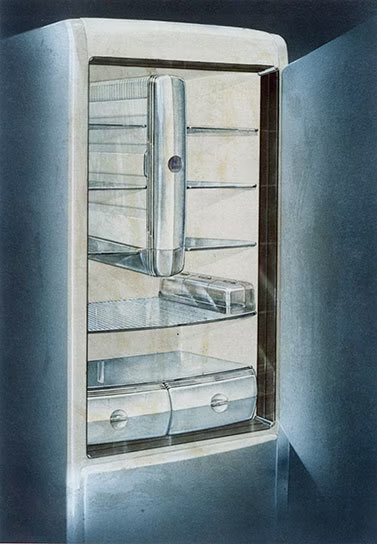
The Coldspot Super Six refrigerator, designed by Raymond Loewy for Sears Roebuck, stands as a landmark in the history of industrial design and consumer products. This iconic appliance revolutionized how households stored food. It also transformed everyday objects’ aesthetic expectations. The Coldspot Super Six Refrigerator: A Design Revolution is this blog post’s focus. It explores the Coldspot’s historical significance, design innovation, and enduring legacy in applied and decorative arts.
Coldspot Super Six Refrigerator design refers to the streamlined industrial redesign by Raymond Loewy in 1934, which transformed refrigeration into a modern consumer product by integrating functional efficiency with aesthetic appeal.
Raymond Loewy: The Visionary Designer
Raymond Loewy, often hailed as “the man who shaped America,” remains one of the most influential industrial designers of the 20th century. His philosophy was straightforward: good design equated to increased sales. This was particularly appealing to manufacturers in the 1930s, who were grappling with the Great Depression. Loewy’s talent for self-promotion set him apart. Additionally, his visionary approach to design was significant. He was not just a designer but a master of creating desire through aesthetics. This is demonstrated in the Coldspot Super Six Refrigerator: a design revolution.
The Birth of the Coldspot
Commissioned by Sears Roebuck, a pioneer in mail-order retailing, the Coldspot refrigerator emerged in an era when functionality and affordability were paramount. Sears revolutionized consumer access to products by offering extended credit terms and easy mail-order options. The Coldspot, introduced in 1934, was a game changer. Loewy’s redesign transformed it from a mundane kitchen appliance into a sleek, desirable object. Time magazine later praised it as “a single smooth, gleaming unit of functional simplicity.” This evolution further cemented the Coldspot Super Six Refrigerator as a design revolution.

Design Innovation and Impact
The Coldspot Super Six Refrigerator was among the first consumer products to employ the streamlined, sculptural lines that became a hallmark of 1930s design. Loewy’s sophisticated metal forming techniques, dry-type insulation, rustproof aluminum shelving, and touch-a-bar door opener exemplified the fusion of form and function. The famous Rotoseal unit ensured a tight seal, preserving food freshness. The automatic interior light improved visibility. These features made refrigeration more convenient for households. The distinctive blue Coldspot logo further added to its allure, symbolizing modernity and elegance in American homes. This true revolution in design made a significant impact.
This design innovation was not merely about aesthetics; it had practical implications, too. The Coldspot’s user-friendly features included 10 freezing speeds and a convenient handi-bin, catering to diverse household needs. Its porcelain interior and rustproof shelves ensured longevity. The ability to produce 105 ice cubes highlighted its efficiency in an era when refrigeration was still a luxury. These thoughtful innovations resonated with consumers. This led to a five-fold increase in sales within two years. This success underscored the power of design in influencing consumer behaviour and setting a new standard for household appliances.
Design Insight: The Coldspot exemplifies the transition from decorative styling to functional modernism, where visual form is derived from engineering logic rather than ornament.
The Coldspot’s Legacy and Influence
The Coldspot’s impact extended beyond its initial success. It signalled the beginning of the “objects of desire” trend. In this trend, everyday items were designed to be functional and beautiful. This shift was pivotal in the evolution of consumer culture. The appearance of products became as important as their utility. The Coldspot Super Six Refrigerator was indeed a design revolution that changed perceptions.
Loewy’s influence on industrial design extended to other areas, such as Greyhound buses, Lucky Strike cigarette packets, and corporate logos. His work demonstrated that good design could drive business success, a principle that resonates in today’s market.
Electrolux and the Cold War Design Race
The Coldspot’s success also had international ramifications. In the 1930s, as consumer preferences shifted towards stylish and reliable kitchen appliances, Electrolux founder Axel Wenner-Gren recognized the need for superior design. He recruited top American designers, including Loewy, to create products that could compete globally. The Electrolux gas absorption fridge, a staple in middle-class European homes, exemplified this approach. This global impact underscored the Coldspot Super Six Refrigerator’s role in the design revolution.
During the Cold War, Electrolux adapted to technological advancements and market demands by transitioning to compressor fridges. The acquisition of Elektro-Helios in 1962 marked a turning point, enabling Electrolux to produce larger and more efficient refrigerators. This adaptability ensured their continued success in a competitive market.
Coldspot’s Evolution and Endurance
The Coldspot brand, established in 1928, expanded beyond refrigerators to include freezers, dehumidifiers, and air conditioning units. These products were manufactured by Seeger Refrigeration and later by Whirlpool and were synonymous with quality and innovation. The Coldspot line continued until 1976 when the Kenmore brand replaced it, yet its legacy in industrial design endures. Such evolution was part of the Coldspot Super Six Refrigerator: a design revolution journey.
Sources
Coldspot. (2022, February 22). In Wikipedia. https://en.wikipedia.org/wiki/Coldspot
Electrolux Group. (n.d.). Electrolux uses design as a weapon in the Cold War. Retrieved June 18, 2024, from https://www.electroluxgroup.com/en/electrolux-uses-design-as-a-weapon-in-the-cold-war-26750/
McDermott, C. (2008). Contemporary Design: Design Museum: Date, 1900-today. United Kingdom: Carlton.
More on Product Design

KUKA Home Meditation Stool: Sculptural Ergonomics and the Design of Stillness
The KUKA Home Meditation Stool combines ergonomic design with sculptural aesthetics, enhancing meditation and mindfulness by supporting cross-legged sitting for…
Keep reading
Lotus Cooking: Thoughtfully Cultivated Culinary Ambition
Lotus offers premium small appliances designed for calm and precise cooking, emphasizing intention, elevation, harmony, and empowerment, fostering culinary confidence…
Keep reading
Lindy Airplane (Toy)
The Lindy Airplane, produced by Hubley in the late 1920s, celebrated Charles Lindbergh’s historic flight, reflecting the era’s fascination with…
Keep reading
The PIFCO 1960 Electric Massager: A Look Back at Vintage Personal Care Technology
The PIFCO Electric Massager from the 1960s represents early personal care innovation, reflecting mid-century consumer trends and marketing claims of…
Keep reading
The AEG Hairdryer: A Functionalist Design Classic
The AEG hair dryer, designed by Peter Behrens, reflects early 20th-century functionalism, showcasing material innovation and a design philosophy prioritizing…
Keep reading
Mortar and Pestle: History, Uses, Materials, and Traditional Design
The mortar and pestle are ancient kitchen tools essential for grinding herbs, spices, and making sauces, emphasizing traditional cooking methods…
Keep readingSomething went wrong. Please refresh the page and/or try again.
Related Articles

Discover more from Encyclopedia of Design
Subscribe to get the latest posts sent to your email.