This article forms part of the Decorative and Applied Arts Encyclopedia, a master reference hub providing a structured overview of design history, materials, movements, and practitioners.
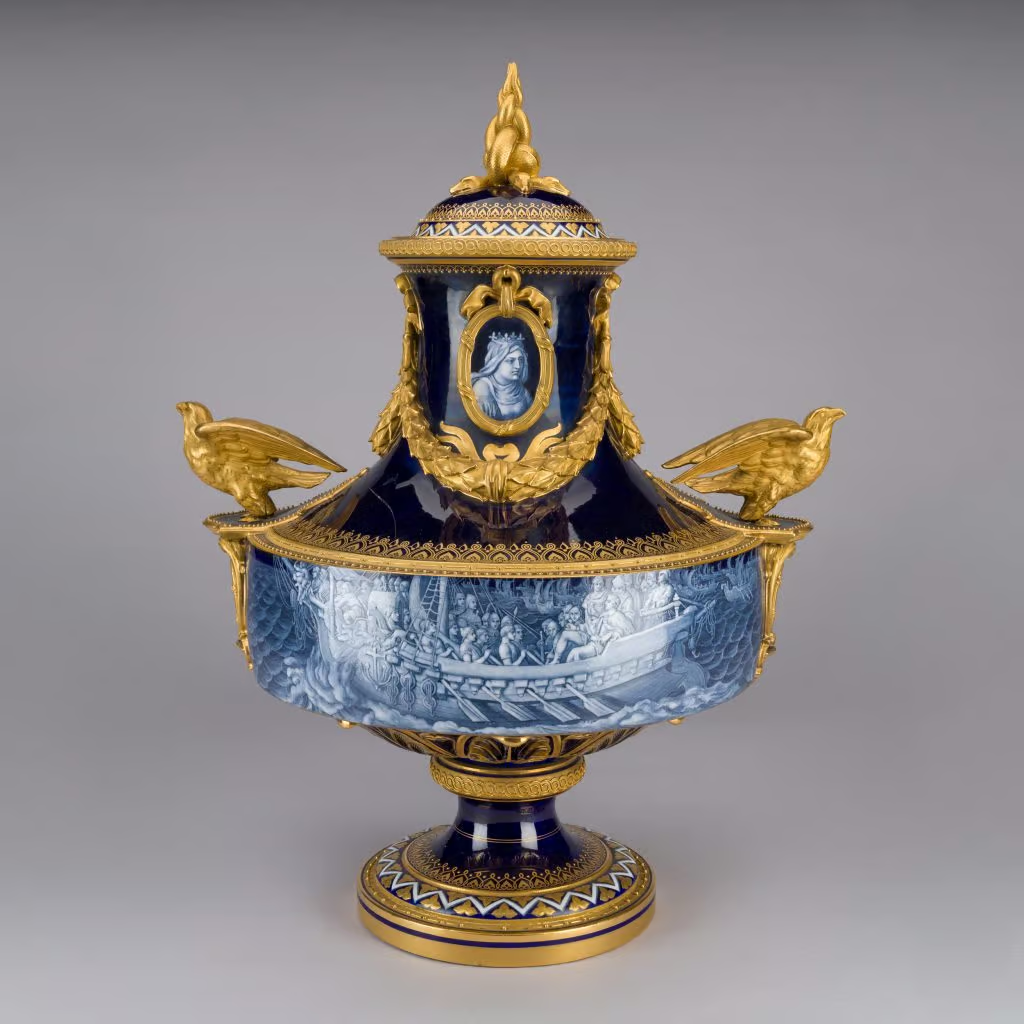
Thomas Bott porcelain painter is a concise way to describe one of the most distinctive figures in nineteenth-century Worcester porcelain. Usually recorded as Thomas Bott (1829–1870), he was an English china painter and designer associated with Kerr & Binns, the Royal Porcelain Works, and the development of Worcester’s celebrated Limoges enamel style on porcelain. His career was comparatively short, but his contribution to Victorian ceramics remains significant for its technical refinement, historical imagination, and highly controlled surface decoration.
Early Life and Training of Thomas Bott Porcelain Painter
Thomas Bott’s early biography is known chiefly through nineteenth-century reference sources and later ceramic histories. The Dictionary of National Biography records him as born near Kidderminster in 1829, although some secondary references give 1828. He was initially brought up in his father’s trade of making spade handles, a practical occupation far removed from the elite world of porcelain painting. According to the same biographical tradition, Bott disliked that work, turned to drawing, and first found employment in a glass factory before supporting himself in Birmingham as a portrait painter.
This path matters because it places Bott within a broader Victorian pattern: skilled decorators often entered ceramic production through drawing, glass painting, enamel work, portraiture, or other applied artistic practices. His early experience appears to have given him a command of fine line, tonal modelling, and meticulous brushwork. These qualities later became central to his reputation at Worcester.
Thomas Bott at Royal Worcester, Kerr & Binns and the Royal Porcelain Works
Bott moved to Worcester in the early 1850s and became one of the principal artists at the Royal Porcelain Works. The Worcester factory was then under the ownership of Kerr & Binns, a period associated with ambitious artistic direction, technical experimentation, and a strong interest in exhibition-quality porcelain. The Museum of Royal Worcester notes that W. H. Binns encouraged Bott to come to Worcester, where he developed his speciality in “Limoges Enamels.”

Worcester had long been a centre of English porcelain production, but the Victorian period gave the factory renewed visibility. Manufacturers such as Worcester, Minton, and Wedgwood competed not only through useful wares but also through technical display, artistic novelty, and elaborate decorative effects. In this context, Bott’s work contributed to Worcester’s reputation for highly skilled hand decoration.
His role should be understood carefully. Victorian porcelain was normally produced through workshop collaboration. A single vase, plaque, or service might involve modellers, throwers, gilders, ground-layers, painters, and finishers. Bott’s significance lies not in solitary authorship of every object associated with his name, but in his mastery of a particular decorative language and his influence on Worcester’s enamel-style production.
Limoges Enamel and Enamel-Style Porcelain Painting
Bott is especially associated with Worcester’s Limoges enamel style. The Museum of Royal Worcester states that enamel work on copper from Limoges, France, inspired Bott to create the Worcester Enamels, and that his work was admired by Prince Albert in 1854. The following year, Worcester’s display at the Paris Exhibition received favourable attention.

Limoges enamel in its historical sense refers to vitreous enamel decoration on metal, particularly copper, developed in France from the medieval period and revived in later collecting and historicist taste. Bott adapted the visual effect to porcelain rather than simply copying the older medium. The result was a form of enamel-style porcelain painting in which pale figures, ornament, and narrative scenes were often rendered against deep, saturated grounds such as cobalt blue or turquoise.
The design significance of this process lies in its fusion of materials. Porcelain, glaze, enamel colour, gilding, and painted modelling combine to produce an object that resembles historic enamel while remaining unmistakably ceramic. The surface becomes both image and ornament. For readers interested in related techniques, Bott’s work sits naturally beside the broader history of enamelwork and nineteenth-century experiments in ceramic surface design.
Major Works and Exhibition Pieces by Thomas Bott
The most frequently cited works associated with Bott are the Norman Conquest Vases in the Museum of Royal Worcester. The museum identifies these vases as decorated by Bott to mark the 800th anniversary of the Norman Conquest. It describes them as the culmination of his Limoges enamel style and notes that the encircling scenes derive from Daniel Maclise’s drawings, which were themselves based on the Bayeux Tapestry.
A Museum of Royal Worcester collection record gives the Norman Conquest vases a date of 1868, identifies the artist as Thomas Bott, and records the material as bone china. The slight difference between anniversary date, design context, and collection date is worth noting. In publication, we should avoid compressing these into a single unsupported claim. The vases are best described as anniversary-related works produced in the later 1860s and preserved as a major example of Bott’s mature enamel-style decoration.
Other works attributed to or signed by Bott appear in museum, auction, and dealer records, including plaques, chargers, and richly decorated vessels. Such records can be useful for object study, but they should be treated as secondary evidence unless supported by museum documentation, factory records, signatures, or authoritative ceramic scholarship. This caution is especially important because Bott’s son, Thomas John Bott, continued the Limoges enamel process after him.
Design Significance in Victorian Ceramic Decoration
Bott’s importance in decorative arts history rests on the sophistication with which he translated a historic enamel language into the porcelain medium. His work demonstrates how nineteenth-century ceramic design could operate at the intersection of painting, antiquarian revival, technical experiment, and luxury manufacture.
The Limoges enamel style required close control of contrast. Pale figure work gained definition through dark grounds, while gilded borders, cartouches, and ornamental framing devices intensified the sense of preciousness. Bott’s decoration often treats the porcelain body as a pictorial field, yet the best examples also respect ceramic form. Curved surfaces, rims, handles, and reserves structure the painted narrative and prevent the object from becoming merely a picture transferred onto a vessel.
This balance between image and object is central to Victorian ceramic design. Bott’s work belongs to a world in which historical revivalism did not simply mean imitation. Instead, designers and manufacturers reinterpreted Renaissance, medieval, classical, and Gothic sources through industrial-era materials, kiln technology, and exhibition culture. In this sense, Bott’s porcelain painting provides a valuable case study in British ceramics as an applied art.
Victorian Ceramics and Cultural Context
The mid-nineteenth century placed British ceramic factories within a competitive international environment. Exhibitions, museum collections, technical manuals, and design reform debates encouraged manufacturers to demonstrate both artistic legitimacy and industrial capacity. Worcester’s enamel-style porcelain responded to this climate by presenting hand-decorated ceramics as refined, historically informed, and technically advanced.
Bott’s work also reflects the Victorian taste for narrative and historical spectacle. The Norman Conquest Vases, with their reference to the Bayeux Tapestry through Maclise’s drawings, show how ceramic decoration could participate in national history, antiquarian study, and public memory. Such pieces were not merely domestic ornaments. They belonged to the culture of display: the cabinet, the exhibition room, the museum, and the elite interior.
At the same time, Bott’s career reminds us that Victorian decorative art depended on disciplined manual skill. The prestige of Worcester porcelain came from bodies and glazes, but also from the painter’s hand. Fine brushwork, tonal control, firing knowledge, and a capacity to adapt pictorial sources to curved ceramic surfaces made Bott’s contribution distinctive.
Legacy and Collecting Relevance
Thomas Bott remains significant to collectors, museums, and ceramic historians because his work represents a recognisable high point in Worcester’s nineteenth-century decorative production. Signed or securely attributed pieces can command attention because they connect a specific artist with a technically demanding factory style.
However, attribution requires care. Collectors should distinguish Thomas Bott senior from Thomas John Bott and other later decorators with similar names or initials. Date, signature, factory mark, style, documented provenance, and comparison with museum examples all matter. Workshop production also means that not every object in the Limoges enamel manner can be assigned to Bott personally.
For museums, Bott offers a useful interpretive bridge between fine art and manufacture. His work complicates any simple division between painter and designer. He painted porcelain, but he also shaped the visual identity of a Worcester speciality. His legacy therefore belongs within ceramic design, decorative arts, material culture, and the broader study of Victorian historicism.
Key Takeaways: Thomas Bott Porcelain Painter
- Thomas Bott was an English porcelain painter and designer, usually recorded as 1829–1870, associated with Royal Worcester and the Royal Porcelain Works.
- He is best known for developing Worcester’s Limoges enamel style, inspired by historic enamel work on copper from Limoges.
- His work helped position Worcester porcelain within Victorian exhibition culture and the market for technically refined decorative ceramics.
- The Norman Conquest Vases are among the most important museum-documented works associated with Bott’s mature style.
- Attribution should be cautious because Worcester production was collaborative and Thomas John Bott continued the Limoges enamel process.
- Bott’s legacy lies in his fusion of painting, enamel effects, historical revivalism, and ceramic form.
Sources
- Museum of Royal Worcester, Norman Conquest Vases object and “Showstopper” records.
- Museum of Royal Worcester, Kerr & Binns factory history and Worcester Enamels notes.
- Museum of Royal Worcester, collections overview for Limoges Enamels and Thomas John Bott distinction.
- Dictionary of National Biography, “Bott, Thomas (1829–1870),” available via Wikisource.
- Art UK, Thomas Bott artist record and self-portrait entry, Worcester Porcelain Museum.
- Christie’s and other major auction records may be used cautiously for signed object examples, market history, and comparative descriptions, not as primary biography.
