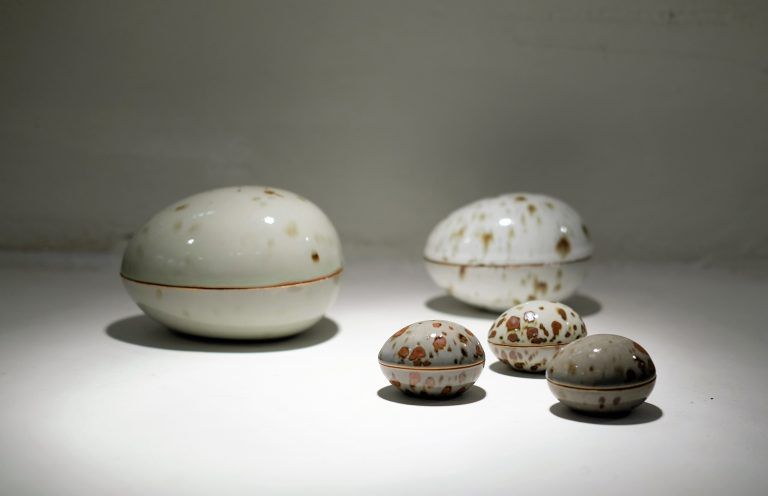
Gunhild Åberg (b.1939) is a Danish Ceramicist. She runs her ceramic gallery and studio in Copenhagen in Lille Strandstræde 14 A (earlier known as Strandstræde Keramik). In her studio, she handcrafts and fires all of her ceramic artworks, which are all unique. Aaberg’s work has been exhibited worldwide and is represented in prominent museums and galleries across several countries.
Education
She studied at the Kunsthändvaerkerskolen, Copenhagen.
Biography
Åberg’s unique ceramic artworks have gained her a reputation as one of Denmark’s most renowned ceramicists. She has received The Danish Arts Foundation’s lifelong Honorary Grant for her contributions to the field. Her studio, located in the heart of Copenhagen, is a testament to her dedication to her craft.
Aberg, Jane Reumert, and Beate Andersen formed the workshop Strandstraede Keramik, Copenhagen. She executed designs for the Royal Copenhagen Porcelain Manufactory and Dansk Designs.
Her use of colour and texture is masterful, with each piece exuding a sense of warmth and vitality that is impossible to ignore. Whether you are an art lover or appreciate fine craftsmanship, visiting Åberg’s studio is an experience not to be missed.
Exhibition
- Work shown at 1975 Stockholm and Hälsingborg Dansk Kunsthaandvaerk’:
- 1975-77 ‘Dansk Miljo’:
- 1976 and 1977 Det Danske Kunstindustrimuseum, Copenhagen;
- 1981 Nordenfieldske Kunstindustrimuseum, Trondheim;
- 1981 ‘Danish Ceramic Design.’ University Park, Pennsylvania.
- Gunhild Åaberg is represented in the National Museum’s collections.
External Links
Sources
Byars, M., & Riley, T. (2004). The design encyclopedia. Laurence King Publishing. https://amzn.to/3ElmSlL
Eijkelenboom-Vermeer, M., Kuyken-Schneider, D. U. (1995). Danish Ceramics. Netherlands: Museum Boymans-van Beuningen.
Speight, C. F. (1983). Hands in Clay: An Introduction to Ceramics. United States: Mayfield.
More on Ceramic Design

Soetsu Yanagi and the Revival of Japanese Folk Art
Soetsu Yanagi, a pivotal Japanese philosopher, founded the Mingei movement, emphasizing the beauty of traditional craftsmanship, thereby preserving folk art…
Keep reading
Karatsu in Japanese Ceramics: A Legacy of Korean Influence and Tea Culture
Karatsu ware, originating in the 13th century, exemplifies Japanese pottery’s rustic elegance with a focus on wabi-sabi aesthetics, particularly in…
Keep reading
The Fitzhugh Pattern: A Classic Oriental Lowestoft Design
The Fitzhugh Pattern, a Chinese export porcelain design from 1815, features an American eagle and symbolizes U.S. trade, reflecting fascinating…
Keep reading
Michael Powolny (1871–1954): Austrian Sculptor and Ceramicist
Michael Powolny was a pivotal Austrian sculptor and ceramicist whose innovative designs significantly influenced Viennese Art Nouveau and early Art…
Keep reading
The Vibrant World of Gaudy Pottery: Dutch, Ironstone, and Welsh
The decorative arts showcase the Gaudy ceramics of the 19th century, highlighting three distinct styles—Gaudy Dutch, Gaudy Ironstone, and Gaudy…
Keep reading
Flow Blue Ceramics: A Guide to This Iconic Tableware
Flow Blue ceramics are renowned for vibrant cobalt designs with blurred patterns. Produced mainly in 19th-century England, they are prized…
Keep reading
Exploring the Art of Majolica: A Glimpse into Vibrant Ceramic Tradition
Majolica is a vibrant pottery form that evolved from Moorish Spain to 19th-century England, cherished for its colorful designs, utility,…
Keep reading
Thorvald Bindesbøll: Pioneer of Danish Art Nouveau
Thorvald Bindesbøll, a key figure in Danish Art Nouveau, revolutionized decorative arts through ceramics, furniture, and graphic design, blending tradition…
Keep reading
Birger Kaipiainen: Master of Finnish Ceramics
Birger Kaipiainen, a Finnish ceramic artist, transformed ordinary pottery with whimsical designs and craftsmanship. His legacy endures, influencing collectors and…
Keep reading