
Flaminio Stadium, Rome, 1956-59 by Pier Luigi Nervi 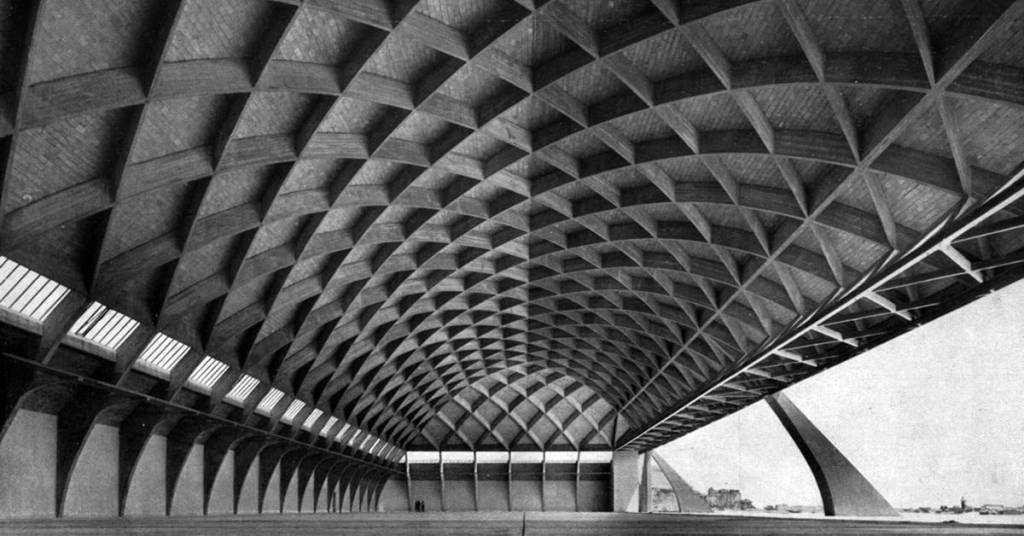
Pier Luigi Nervi. Aircraft hangar, Orvieto, Italy, 1935. 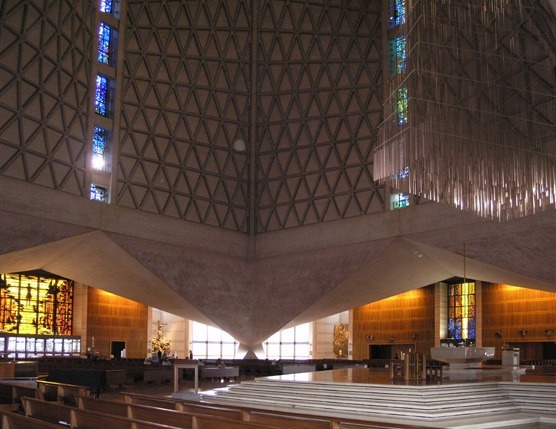
CATEDRAL DE SANTA MARIA by Pier Luigi Nervi
Pier Luigi Nervi (1891 – 1979) was an Italian architect born in Sondrio, Lombardy. He studied engineering at the University of Bologna, to 1913. Nervi’s taut reinforced concrete buildings were among the most spectacular structures of the twentieth century. He became well-known for his beautiful concrete roof creations. Some are cantilevered, while others are precast concrete trusses or vaults of diagonally intersecting concrete beams. He was well known for his concrete spiral stairs.
Education
Pier Nervi Luigi was the sole child of Sondrio’s postmaster. As a youth, he was fascinated by mechanical devices, and at the University of Bologna, his interests broadened to include the mechanics of large-scale engineering projects. He received a degree in civil engineering in 1913 and formed an engineering and construction firm in Rome in 1923.
Early Career
After experience with a concrete contractor, he set up his firm in Bologna in 1923. His first structure was a 1927 cinema in Naples: His first important work was the 1930-32 Communal Stadium in Florence, widely published as an early example of Modern architecture. As he frequently argued in his writings, he believed that the creation of form was an activity equivalent to that of the artist or technician.
Strength through form
He became known as the artist of reinforced concrete. His ‘strength through form’ experiments were expressed in his 1948-49 Turin exhibition building, considered his masterpiece, in which biomorphic units were used in a peripherally supported ceiling of enormous span. He later designed buildings that were simpler and quicker to construct.
While inspired by Italian rationalism, in particular by Terragni, he remained stylistically independent of fashion. His Florence Stadium(1930–2), with its massive cantilevered roof framework and spiral stairs, was the first of several of his buildings to achieve international acclaim.
Between 1946-61, he was a professor of structural engineering in the architecture department of the University of Rome.
Summary of Works
His other buildings included aeroplane hangars in Orvieto of 1935-38 and in Orbetello and Torre del Lago of 1940-43, 1950 Casino at the Lido in Rome. Then in the Great Hall B, Exhibition Hall, Turin(1947–9), he developed a system of superimposed steel mesh encased in concrete that enabled him to create prefabricated corrugated elements with high tensile strength. The result was a building of almost poetic grace.
Between 1953-57 conference hall of the UNESCO building (with Marcel · Breuer and Bernard Zehrfuss) in Paris, 1955-58 Pirelli building (with Gia Ponti and others) in Milan, 1955 Centre National des Industries (with Jean Prouve) in Paris, 1956 circular exhibition building in Caracas (Venezuela), 1956-57 Palazzetto dello Sport Lavoro in Turin, and 1971 Papal audience chamber in the Vatican in Rome.
Source
Byars, M., & Riley, T. (2004). The design encyclopedia. Laurence King Publishing.
Curl, J. S., & Wilson, S. (2015). The Oxford dictionary of architecture. Oxford University Press.
Dizik, A. A. (1988). Concise encyclopedia of interior design. Van Nostrand Reinhold.
Discover more from Encyclopedia of Design
Subscribe to get the latest posts sent to your email.