This article forms part of the Decorative and Applied Arts Encyclopedia, a master reference hub providing a structured overview of design history, materials, movements, and practitioners.
Marialaura Irvine, also known as Marialaura Rossiello Irvine, is an Italian architect and designer whose work bridges product design, creative direction, architecture and material research. As the principal figure behind Studio Irvine in Milan, she has developed a design method grounded in simplification, historical awareness and respect for production processes. Her work does not depend on a fixed visual signature. Instead, it reveals a disciplined way of thinking: begin with the material, understand the industrial context, clarify the object’s purpose, and reduce what is unnecessary.

This approach places Marialaura Irvine within a significant lineage of Italian design, where the object is rarely treated as a purely formal exercise. It is part of a broader system: manufacturing, communication, corporate identity, use, memory and environment. Her practice also reflects a contemporary concern with sustainability, particularly through mono-materiality, reduced waste and the search for durable, timeless solutions.
Early Formation: Naples, Riccardo Dalisi and Strategic Design in Milan
Born in 1972, Marialaura Rossiello Irvine studied architecture in Naples under Riccardo Dalisi. This early formation is important. Dalisi’s work combined architecture, craft, social imagination and poetic experimentation, and Irvine’s later design philosophy retains a clear respect for narrative, tradition and the cultural life of materials.

In 2000, she moved to Milan to study Strategic Design at the Politecnico di Milano. This move expanded her architectural training into the language of product strategy, marketing and communication. Rather than seeing an object as an isolated artefact, she learned to understand it as part of a comprehensive corporate process. This perspective remains central to Studio Irvine’s practice. A chair, table, handle, surface or interior is not simply designed; it is positioned within a system of production, identity and use.
This dual education—poetic architectural culture in Naples and strategic industrial thinking in Milan—helps explain the balance in Irvine’s work. Her projects are rarely theatrical, yet they are not anonymous. They are precise, materially attentive and often quietly expressive.
Studio Irvine and the Legacy of James Irvine
Marialaura Irvine’s professional life is closely associated with Studio Irvine, the Milan-based architecture and design studio founded by her late husband, British designer James Irvine. In 2009, she became a partner in the firm. After James Irvine’s sudden death in 2013, the studio entered a new phase under her direction.
This transition did not sever the studio from its industrial roots. Instead, it extended them. Studio Irvine’s design culture has been described through three key terms: precision, irony and generosity. Precision appears in the design of products and spaces. Irony emerges in communication and in the lightness with which ideas are sometimes framed. Generosity is visible in art direction, collaboration and the studio’s willingness to work across disciplines.
Marialaura Irvine’s practice also reflects a cross-cultural design language. Italian design provides the context of industry, material culture and manufacturing intelligence. British design contributes pragmatism, understatement and attention to everyday use. The result is a method that moves between furniture, surfaces, interiors and corporate identity without becoming stylistically fixed.
Metodo Irvine: Simplification, Material Respect and Timeless Design
Studio Irvine describes its mission as simplifying design in order to improve both the object and its production. This is not minimalism as an aesthetic fashion. It is a disciplined method. The studio’s work begins with material research and follows the transformation of that material through production, communication and product strategy.

The studio’s stated principles include collective work, respect for materials and production processes, coherent corporate identity, respect for genius loci, the creation of spatial alchemies through light and texture, and an aspiration to the timeless. These principles help explain why Irvine’s practice can move from a chair to a surface, from furniture to architecture, and from art direction to interior atmosphere.
Her research is closely linked to mono-materiality. This does not mean using one material dogmatically. Rather, it means seeking synthesis. By reducing unnecessary material complexity, a product can become clearer, easier to understand, more efficient to produce and less wasteful. In this sense, Marialaura Irvine’s work belongs to the broader contemporary movement toward sustainable design, but without the visual rhetoric that often accompanies ecological claims.
Materials are not treated as decoration. They operate structurally, conceptually and emotionally. In Studio Irvine’s philosophy, form follows from the material and from the process. This view connects her practice to long-standing debates in modern design, from the craft-industry relationship of the Arts and Crafts movement to the industrial clarity associated with the Bauhaus. Yet Irvine’s work is distinctly contemporary because it also incorporates brand strategy, communication and environmental responsibility.
Furniture and Product Design: Donna, Paf Paf and Discipline Projects
Marialaura Irvine has collaborated with a wide range of design companies, including Arper, Muji, Thonet, MDF Italia, FormaCemento, Olivari, Mattiazzi, Baleri Italia, Discipline and Matteo Brioni. These collaborations show the versatility of her practice and the confidence with which she works across different scales and material traditions.
For Baleri Italia, Irvine designed the Donna chair, presented in both stackable and upholstered versions. The design combines a slender tubular structure with a restrained seat and back. In the stackable version, Donna addresses practical needs associated with contract and flexible interiors. In the upholstered version, the chair gains softness without losing its structural clarity. It is a useful example of Irvine’s ability to balance simplicity, comfort and production logic.
For Mattiazzi, Irvine designed the MC 25 — Paf Paf chair, also represented by District Furniture as the Paf Paf chair and lounge chair. The design uses generous cushions and rounded timber elements to create a relaxed, almost informal presence. Yet the object remains carefully structured. It shows that Irvine’s simplification does not necessarily produce severity. Her work can be warm, tactile and domestic while still disciplined in construction.

Her work for Discipline includes the Sakti table, Bunchy accessories and the Sakti Coat Hanger. These projects extend her interest in timber, proportion and everyday use. The Sakti Coat Hanger, for example, suggests a ladder-like structure, transforming a simple storage object into a spatial gesture. Bunchy explores the vessel-like qualities of turned timber forms, while Sakti applies clear structural logic to the table typology.
Architecture and Surface: The Pienza Farmhouse with MatteoBrioni
Marialaura Irvine’s work is not limited to furniture. A significant example of her architectural and material thinking is the private residence in Pienza, Tuscany, developed with MatteoBrioni. The project transformed an ancient farmhouse belonging to Swedish photographer Mikael Jansson into what MatteoBrioni describes as a livable art installation.
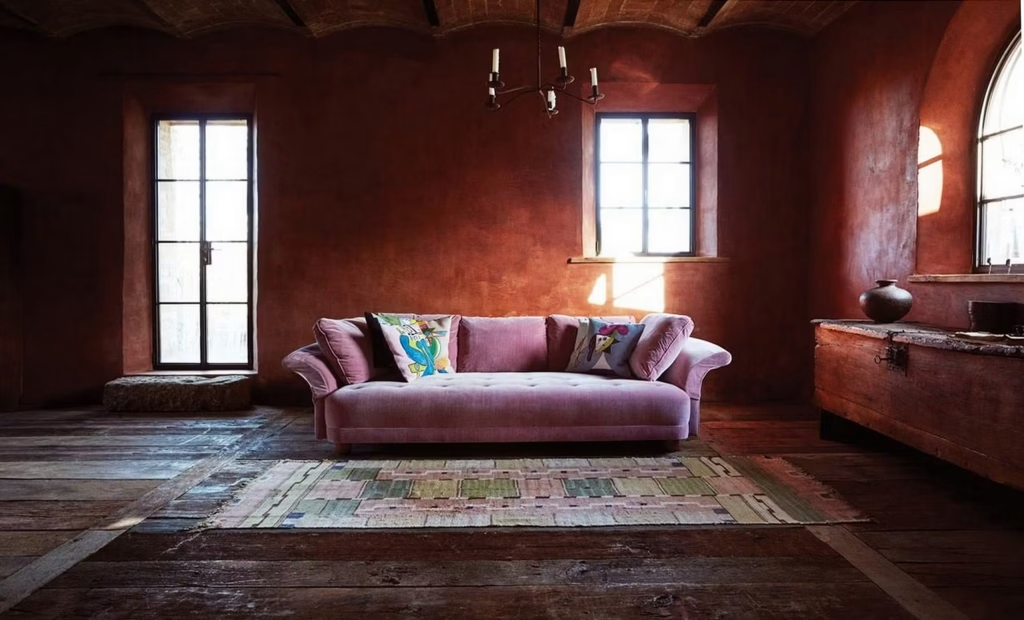
The Pienza project is especially important because it was the first MatteoBrioni Bespoke project and the context in which the company’s Wabi effect was born. The material research involved clay, black soap and lime putty, with chromatic references rooted in Sienese earth tones. Over more than a year, the project developed a carefully aged atmosphere, not as imitation, but as a way of allowing the house to appear shaped by memory and time.
Each room was given a different hue, using tones such as Melograno, Caffè, Vinaccia and Zenzero. The surfaces interacted with antique doors collected from flea markets across Europe. In this project, Irvine’s respect for genius loci becomes tangible. The design does not impose a generic contemporary interior onto a Tuscan farmhouse. Instead, it works with the atmosphere, colour, texture and material memory of the place.
This project also clarifies why surfaces are central to Studio Irvine’s practice. A wall is not merely a background. It can be a material field, a carrier of light, a historical register and a tactile presence. In this sense, Irvine’s architectural interiors extend the same principles found in her products: respect the material, understand transformation and avoid superficial decoration.
Design Significance: A Radical Whisper in Contemporary Design
Marialaura Irvine’s design philosophy has been described as a “radical whisper.” The phrase is useful because it captures the quiet intensity of her work. Her designs rarely shout. They do not depend on expressive excess, novelty for its own sake or aggressive visual branding. Instead, they ask for attention through proportion, tactility, process and use.

This quietness should not be mistaken for neutrality. Irvine’s work carries a clear ethical position. It argues for fewer materials, better relationships between design and production, and a deeper understanding of how objects belong within corporate, domestic and architectural environments. In a period when design is often judged by image circulation, her work returns attention to method.
Her importance also lies in her ability to connect design disciplines. She works as an architect, product designer, creative director and material researcher. This cross-disciplinary model reflects the current state of professional design, where furniture, interiors, surfaces, branding and sustainability increasingly overlap. Studio Irvine provides a model for how these areas can be integrated without losing clarity.
Key Takeaways: Marialaura Irvine and Studio Irvine
- Marialaura Irvine is an Italian architect and designer based in Milan.
- She studied architecture in Naples under Riccardo Dalisi and later Strategic Design at Politecnico di Milano.
- Studio Irvine works across product design, creative direction, architecture, materials and surfaces.
- Her design method emphasises simplification, mono-materiality, production intelligence and reduced waste.
- Key projects include Donna for Baleri Italia, Paf Paf for Mattiazzi, and Sakti, Bunchy and Sakti Coat Hanger for Discipline.
- The Pienza farmhouse project with MatteoBrioni demonstrates her sensitivity to place, surface, colour and material atmosphere.
Marialaura Irvine in the Context of Italian Design
Marialaura Irvine’s work helps us understand the continuing vitality of Italian design in the twenty-first century. Earlier generations of Italian designers often moved fluidly between architecture, furniture, product design and brand culture. Irvine continues this tradition, but with a contemporary emphasis on sustainability, material reduction and strategic coherence.

Her work also sits beside a broader Italian design culture represented by figures and firms such as Vico Magistretti, Alessandro Mendini, Ettore Sottsass, Kartell, Alessi and Baleri Italia. Unlike the more overtly radical or expressive strands of Italian design, Irvine’s contribution is measured and process-led. Her work suggests that the future of Italian design may lie as much in intelligent reduction as in formal invention.
For Encyclopedia Design, Marialaura Irvine deserves attention because her career links several themes central to contemporary applied arts: the relationship between craft and industry, the role of women in design leadership, the intelligence of material systems, and the ongoing importance of design as a cultural and strategic discipline.
Sources
Baleri Italia. (n.d.). Marialaura Irvine. Retrieved June 29, 2026, from https://baleri-italia.com/en/designers/marialaura-irvine
Discipline. (n.d.). Marialaura Rossiello Irvine. Retrieved June 29, 2026, from https://www.discipline.eu/en/designers/marialaura-rossiello-irvine
District Furniture. (n.d.). Marialaura Irvine. Retrieved June 29, 2026, from https://www.district.com.au/pages/marialaura-irvine
Mattiazzi. (n.d.). Marialaura Irvine. Retrieved June 29, 2026, from https://www.mattiazzi.eu/designers/marialaura-irvine/
MatteoBrioni. (n.d.). Marialaura Rossiello – Studio Irvine: Private residence in Pienza, Tuscany. Retrieved June 29, 2026, from https://matteobrioni.com/project/marialaura-rossiello-studio-irvine/
Studio Irvine. (n.d.). About: The studio. Retrieved June 29, 2026, from https://www.studio-irvine.com/about/
