This article forms part of the Decorative and Applied Arts Encyclopedia, a master reference hub providing a structured overview of design history, materials, movements, and practitioners.
The Shimmer Chair creation resulted from a joint partnership between the University of Western Australia and the Forest Products Commission of the Government of Western Australia undertaken by the Advanced Timber Concepts Research Centre (ATC). ATC’s overall goal is to establish outstanding practices in environmental and industrial sustainability for the use of plantations and native timber.
In design-led research carried out by ATC, the Shimmer Chair and Table are paradigmatic. Manufactured in Karri, Jarrah and Sheoak, native Western Australian eucalyptus trees, they exploit the strength and aesthetic character of these timbers to produce elegant, lightweight, highly durable forms.
Crafted from solid timber and coupled with advanced joinery techniques, the Shimmer Chair combines a sophisticated aesthetic with intense durability utilising the inherent qualities of Western Australian hardwoods.
This is the first project conducted by the ATC for concept lead studies. It emerged from the discovery that local furniture manufacturers discarded timber with a cross-section of 20mm x 20mm or less. They adopted this size to incorporate the design according to sustainable practise as the limit for the materials from which the chair was to be built.
It was also noted that timber furniture tended to be heavy, rigid, flat, and to rely on comfort upholstery. This chair was to be light, flexible, textured and comfortable, although only solid timber was still being built. The timber species Jarrah and especially Karri were suitable candidates, which have a long straight grain and excellent strength.
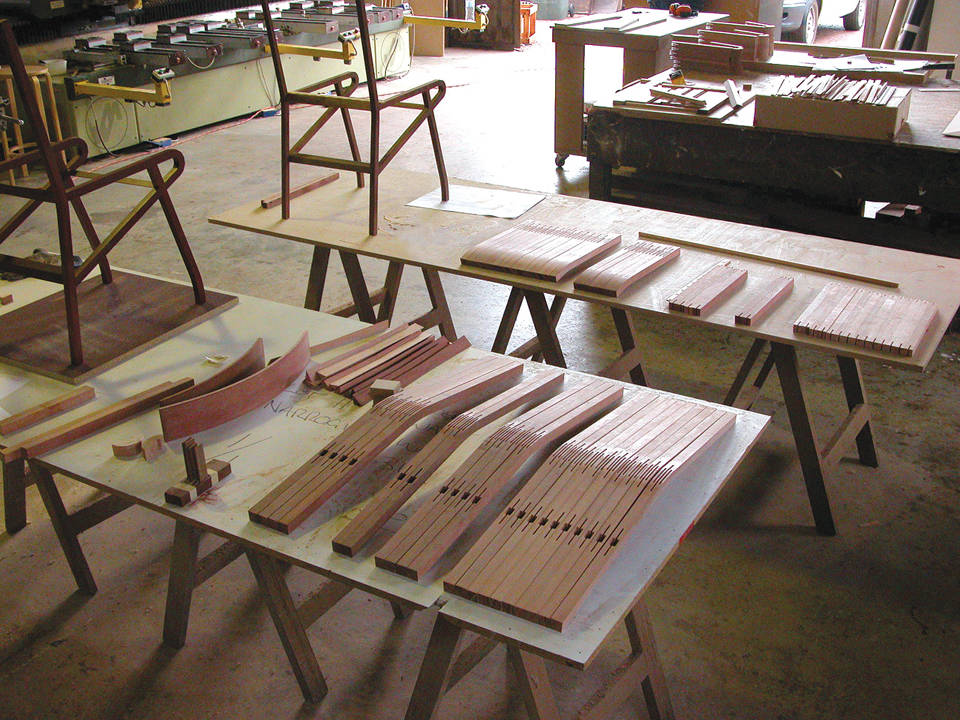
To allow three-way joints to occur, sophisticated jointing techniques were applied to the small timber sections; no other timber chair is entirely constructed with such small square section components. The work on this chair has led to a new research project on the jointing of timber with small section sizes, resulting in the creation of a timber furniture software design programme.
In the manufacturing of the chair, other manufacturing methods such as steam bending and surface milling were also used, and a combination of these two techniques was used to make the distinctive woven back to the chair. To allow them to flex, all components were sized so that comfort was an integral feature of the components rather than being applied through the upholstery. The specially textured surface that the surface milling creates ‘ shimmers’ applied to the seat battens.
In the final analysis, the chair relies on being an integrated structure where all joints and members working together give strength and flexibility.
More on Australian Design

Ric Gath: The Reluctant Revolutionary of Surf Safety
Ric Gath, an Australian surfer-inventor, created the first surf-specific helmet in 1989, redefining surf safety and leaving a lasting legacy…
Keep reading
1971 Nota Type IV ‘Fang’: A Classic Australian Sports Car
The 1971 Nota Type IV ‘Fang’ prototype is a significant Australian sports car, offering high performance, lightweight design, and bridging…
Keep reading
Craftsmanship and Innovation in Marc Newson’s Wood Chair
Marc Newson’s Wood Chair is a biomorphic masterpiece showcasing innovative bentwood craftsmanship, merging organic form and durability, influencing contemporary furniture…
Keep reading
Gordon Andrews: A Pioneer in Australian Design
Gordon Andrews, influential Australian designer known for diverse work, including banknote design, showcased international style amidst mid-20th century. Legacy continues…
Keep reading
Julie Blyfield: Celebrating Australian Silversmithing and Jewellery
Julie Blyfield, a leading Australian silversmith and jeweller, intertwines traditional techniques with contemporary art, crafting pieces reflecting cultural heritage and…
Keep reading




The Art of the Curious: Marc Newson’s Cabinet of Curiosities for Louis Vuitton
Australian designer Marc Newson collaborates with Louis Vuitton to create a modern Cabinet of Curiosities, redefining luxury storage and personal…
Keep readingSomething went wrong. Please refresh the page and/or try again.
Related Articles
Discover more from Encyclopedia of Design
Subscribe to get the latest posts sent to your email.