This article forms part of the Decorative and Applied Arts Encyclopedia, a master reference hub providing a structured overview of design history, materials, movements, and practitioners.

Nora Gulbrandsen (1894–1978) was a Norwegian ceramic artist and porcelain designer best known for her innovative work with Porsgrunds Porselænsfabrik. During the interwar period she helped modernise Norwegian porcelain design through bold colour combinations, cubist-inspired forms, and decorative motifs influenced by the international Art Deco movement. Gulbrandsen became one of the most important figures in early twentieth-century Scandinavian ceramic design.
Biography
She was born to Aksel Julius Hanssen and Anna Sofie Lund in Kristiania (now Oslo), Norway. From 1917 until 1922, she was married to wholesaler Carl Ziegler Gulbrandsen (1892–1976). She married Otto Delphin Amundsen, an engineer and genealogist, in 1943
From 1923 to 1927, Gulbrandsen studied at the Norwegian National Academy of Craft and Art Industry (Statens håndverks- og kunstindustriskole) in Oslo. After graduating she began working as a designer at Porsgrunds Porselænsfabrik, Norway’s leading porcelain manufacturer. From 1928 until 1946 she served as the company’s creative director, designing numerous porcelain collections that became commercially successful during the interwar years. After leaving Porsgrund, Gulbrandsen established her own pottery workshop in Oslo in 1946.
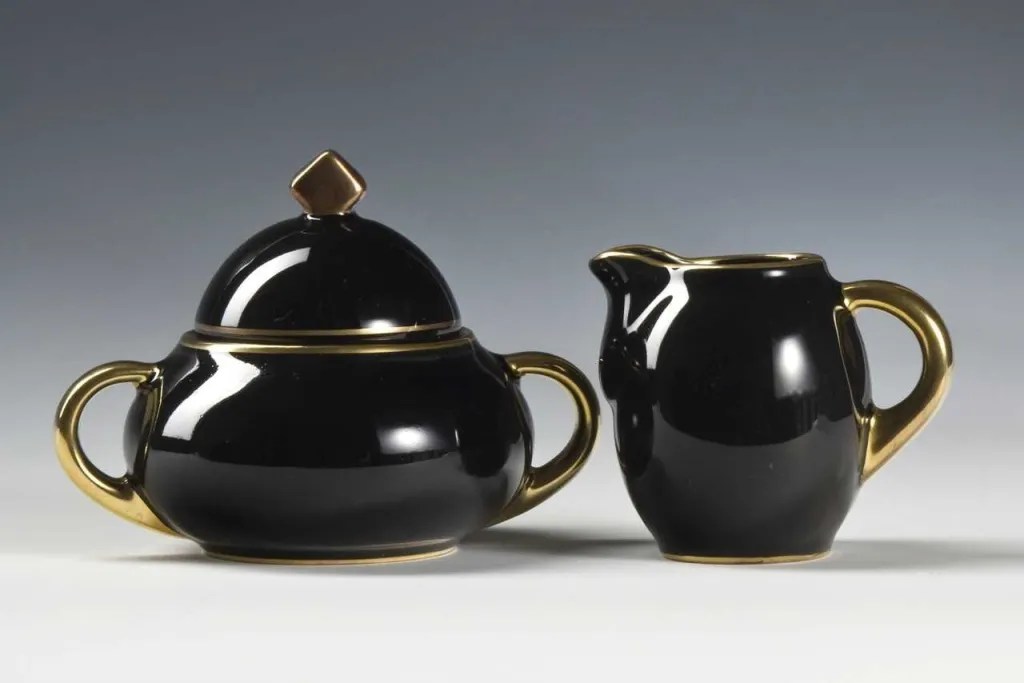
During her time at Porsgrund, Gulbrandsen created more than 300 different porcelain designs and models. Her work often featured cubist-inspired forms and striking colour contrasts, combining bright and dark tones in ways that reflected the influence of the international Art Deco movement. Today many examples of her ceramics are preserved in museum collections, including the Porsgrunn City Museum (Porselensmuseet), which maintains an important archive of her work.
During the German occupation of Norway in the Second World War, Porsgrund continued production and supplied porcelain tableware and gift items ordered by German authorities, a complex historical context that later affected perceptions of the factory and its designers.
Wartime Porcelain and Viking Imagery
During the German occupation of Norway in the Second World War, Porsgrunds Porselænsfabrik continued producing porcelain for a variety of clients, including German military authorities. Some of the objects produced during these years featured motifs such as Viking ships, Norwegian landscapes, and maps of Norway.
These images appealed to German soldiers stationed in the country and appeared on commemorative plates, gift items, and souvenir objects made for military units. Viking imagery in particular had symbolic importance in German propaganda, which presented Scandinavia as part of a broader Nordic cultural heritage.
Research suggests that several of these motifs were not created specifically for wartime propaganda. Instead, they may have developed from tourist souvenir designs that Nora Gulbrandsen had already produced for the Norwegian market before the war. (Lund, 2021)
Examples of this wartime porcelain are preserved in museum collections and have been studied by Norwegian researchers and museums including Telemark Museum.
Nora Gulbrandsen and the Development of Functionalism in Norway
During the late 1920s and early 1930s, Norwegian decorative arts began to reflect broader developments in Scandinavian modern design. When Nora Gulbrandsen joined Porsgrunds Porselænsfabrik in 1927, she contributed significantly to the transformation of porcelain table services by simplifying forms and reducing decorative ornament. Her work reflected the emerging functionalist approach that was spreading across Scandinavia during this period.
At the same time, Norwegian silver design was also moving toward greater formal clarity. Workshops such as J. Tostrup and David Andersen introduced simplified designs influenced by French Art Deco aesthetics. Although these modern ideas gained influence, Norwegian designers often combined them with decorative traditions rooted in national craft culture.
These developments formed part of the wider Scandinavian movement toward functional design that culminated in the influential Stockholm Exhibition of 1930. By this time, Scandinavian designers were well prepared to engage with modernism through a combination of industrial development, strong craft traditions, and a generation of innovative designers working across ceramics, metalwork, furniture, and architecture.
Her work was displayed in the Norwegian Society of Arts and Crafts exhibition in Bergen in 1927.
Design Style of Nora Gulbrandsen
The ceramic designs of Nora Gulbrandsen are recognised for their distinctive modernist character. Working during the interwar years, she experimented with geometric forms, stylised decorative motifs, and bold colour palettes. These qualities reflected the influence of European Art Deco while maintaining the clarity and elegance associated with Scandinavian design.
Many of her porcelain objects were designed for everyday use, including plates, bowls, tea services, and decorative vessels. Through these works Gulbrandsen helped introduce a modern visual language to Norwegian porcelain manufacturing.
Porsgrund Porcelain and the Rise of Modern Norwegian Design
During the early twentieth century, Porsgrunds Porselænsfabrik played a crucial role in modernising Norwegian decorative arts. Founded in 1885 in the town of Porsgrunn, the factory quickly became the most important porcelain manufacturer in Norway.
When Nora Gulbrandsen joined the company in the late 1920s, European design was undergoing a dramatic transformation. The influence of Art Deco, Cubism, and emerging modernist ideas encouraged designers to experiment with simplified forms and bold decorative patterns.
Gulbrandsen embraced these new ideas. Her porcelain designs combined geometric ornament, vibrant colour contrasts, and stylised motifs that departed from traditional nineteenth-century porcelain decoration. Through this work she helped introduce a distinctly modern visual language to Norwegian ceramics.
Today the porcelain produced at Porsgrund during this period is considered an important chapter in the history of Scandinavian design, demonstrating how industrial production and artistic innovation could successfully merge.




Nora Gulbrandsen and Scandinavian Functionalism
During the early 1930s, Scandinavian design underwent a significant transformation as functionalist ideas spread across architecture, furniture, and the decorative arts. Designers increasingly rejected heavy historical ornament in favour of simpler forms, geometric clarity, and objects intended for everyday use.
Within this context, Nora Gulbrandsen played an important role in modernising Norwegian porcelain design. At Porsgrunds Porselænsfabrik she developed a series of table services characterised by clean geometric forms and carefully balanced colour contrasts. These designs reflected the broader Scandinavian movement toward functional design that could be produced efficiently while maintaining a refined aesthetic quality.
Gulbrandsen’s work appeared alongside that of other Scandinavian modern designers such as Aino Aalto, Wilhelm Kåge, and Kurt Ekholm, who were similarly exploring new approaches to ceramics and industrial design. Together, these designers helped establish the foundations of modern Scandinavian design culture during the interwar period.
Sources
Byars, M., & Riley, T. (2004). The design encyclopedia. Laurence King Publishing.
Lund, K. (2021). Hvitt gull med brune flekker? Nora Gulbrandsen og Porsgrunds Porselænsfabrik 1940–1945. Kunst og Kultur, 104(4), 204–219. https://doi.org/10.18261/issn.1504-3029-2021-04-02
McFadden, D. R. (1982). Scandinavian modern design, 1880–1980. New York: Abrams.
Published in association with the Cooper-Hewitt Museum, the Minnesota Museum of Art, and the Renwick Gallery.
Polster, B. (1999). Design Lexikon Skandinavien. DuMont.
More Ceramic Design

John Armstrong (1893–1973): British Painter, Designer and Ceramic Artist
John Armstrong was a distinctive figure in twentieth-century British art whose work encompassed painting, murals, advertising, theatre, cinema and ceramic design.

Castelli Maiolica Apothecary Jug: Renaissance Form and Function
This sixteenth-century Castelli maiolica apothecary jug unites a functional spout and handle with vivid female profile portraits and the medicinal inscription “oximel”.

Doulton Silicon Ware: History, Decoration and Revival
Doulton Silicon Ware was a distinctive high-fired English stoneware made at Lambeth, recognised for its matt smear glaze and carved, incised, perforated and applied decoration.

Gosu Aka-e: Chinese Porcelain in Japanese Ceramics
Gosu aka-e is a bold, red-overglaze porcelain originating from southern China, later adapted by Japanese potters, particularly Okuda Eisen, influencing tea culture and ceramic tradition.

Carrot’s Den Donut Vase Set: Sculptural Ceramics for Modern Shelves
Warm-white ceramic and open circular silhouettes make the Carrot’s Den donut vase set feel as much like small sculpture as functional vessels.

Josep Llorens Artigas: Master of Modern Ceramic Glazes
Josep Llorens Artigas was a pivotal Catalan ceramic artist, blending technical skill with modern art, influencing ceramics as a significant art form through his collaborations and innovative glazes.
Related Articles
