This article forms part of the Decorative and Applied Arts Encyclopedia, a master reference hub providing a structured overview of design history, materials, movements, and practitioners.

The Pre-Raphaelites were a group of British artists.
The Pre-Raphaelite Brotherhood (PRB) was founded in 1848 by three young men at the family home of John Everett Millais on Gower Street in London. They quickly expanded to include another painter, two authors, and a sculptor.
From 1848, the Pre-Raphaelite Brotherhood was led by Dante Gabriel Rossetti and Edward Burne-Jones. Their vision of the feminine figure and face was influenced by fairy-tale imagery, early Renaissance artists, and William Morris’s wife, Janey. They emphasised the neck and head, and Renaissance-style necklaces with pendants were the most popular jewellery in their works. Burne-Jones and Rosetti were inspired by sensual Oriental and North African jewellery and collected it.

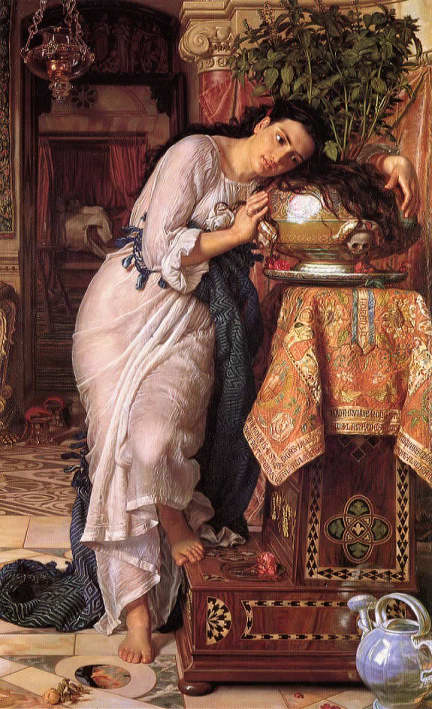


Dante Gabriel Rossetti (1828 – 1882)
He was especially enamoured of medieval Italian art and poetry. In 1860, Rossetti married Elizabeth Siddal, a model who set the standard for brotherhood. Their first child was born stillborn. Siddal died of an overdose of laudanum, an opiate. Rossetti placed in her coffin the manuscript of poems that he had intended to publish. In 1869, he had her coffee exhumed to retrieve the notebook and publish “Poems”. In 1871, Rossetti and his friend William Morris shared a country house in Oxfordshire. With Morris away in Iceland that Summer, Rossetti and Morris’s wife Jane, who was the model for many of his later paintings, including “Walter Willow” (1871), fell in love and had an affair. He lived much of his life with mental illness and substance abuse, dying on Easter in 1882.
John Everett Millais (1829 – 1896)
In 1853, he went on a painting exhibition to Glenfinlas, Scotland, with his brother William, the critic John Ruskin – a huge supporter of the PRB and Ruskin’s wife Euphemia, or Effie. Millais and Effie fell in love, and within a year, she was granted an annulment for her marriage to Ruskin because it had not been consummated. She and Millais were married in 1855. Millais’ painting style moved closer to that of the Royal Academy. He was president for several months before he died.
William Holman Hunt
Through Millais, he befriended Rossetti and helped launch the PRB. In early 1854, Hunt visited Jerusalem, where he sketched and painted biblical subjects in their proper settings. Two resulting works, “The Finding of the Saviour in the Temple” 1854 – 1860 (Birmingham Museum and Art Gallery) and “The Afterglow in Egypt” (1854-1863, Southampton City Art Gallery), solidified his reputation and his finances. He married the model Fanny Waugh in 1865; one year later, she died during the birth of their son. In 1875, he travelled to Switzerland to marry Fanny’s younger sister, Edith, because the English church did not allow a widower to marry his dead wife’s sister.
James Collinson (1825 – 1892)
Rossetti recruited him to join the PRB. In 1848, he converted from Catholicism to Anglicanism to anchor his engagement with Christina Rossetti, Dante Gabriel’s sister. He reverted to Catholicism two years later, and the engagement ended. Millais’ 1850 painting, “Christ in the House of His Parents,” attracted accusations of blasphemy, including by Charles Dickens. A controversy ensued, and Collinson left the PRB. After considering replacements, the remaining members disbanded.
Thomas Woolner (1825 – 1892)
A sculptor and poet, he is best known for his portrait sculptures and medallions, which, though often classical, displayed an attention to detail that melded with the aims of the PRB. His poem “My Beautiful Lady” appeared in the first issue of the PRB’s short-lived magazine, “The Germ.” In 1875, he was elected to the Royal Academy, where he was professor of sculpture from 1877 to 1879. He was a friend of Alfred Tennyson and was in contact with Charles Darwin, who was so impressed by Woolner’ssculpture “Puck” and by his discussions of anatomy that he named part of the ear the “Woolberian tip.”
Frederic George Stephens (1828 – 1907)
Stephens met Millais and Hunt in 1844 at the Royal Academy. He tried his hand at drawing and painting; however, he made his name as an art critic, sharing with readers the philosophy of the PRB. He wrote for several publications, notably the literary magazine “Anenaeum.”
William Michael Rossetti (1829 – 1919)
An art critic and Dante Gabriel’s younger brother, he acted as secretary of the PRB and edited “The Germ.” He wrote a volume 1889 about Dante Gabriell’s paintings and poetry and published a biography of his brother in 1895. He also edited much of his sister Christina’s poetry.
Sources
Byars, M., & Riley, T. (2004). The design encyclopedia. Laurence King Publishing.
Yasidjko, C. (2007, September 23). The Pre-Raphaelite Brotherhood. The News Journal, p. A12.
More on Art and Design

Menuisier: The French Joiner in the Hierarchy of Furniture Making
During the 17th and 18th centuries, the French menuisier crafted essential furniture from solid wood, distinguishing their work from the…
Keep reading
Eugène Grasset | Art Nouveau Ornament, Botanical Design & Theory
Eugène Grasset, a pivotal Art Nouveau figure, combined nature-inspired ornamentation with modern functional design principles, significantly influencing decorative arts and…
Keep reading
Omega Workshops: Modern Art Comes Home
The Omega Workshops, founded by Roger Fry, aimed to integrate modern art into domestic design, challenging traditional aesthetics and emphasizing…
Keep readingSomething went wrong. Please refresh the page and/or try again.
Related Articles
Discover more from Encyclopedia of Design
Subscribe to get the latest posts sent to your email.