This article forms part of the Decorative and Applied Arts Encyclopedia, a master reference hub providing a structured overview of design history, materials, movements, and practitioners.

David Mellor was a British artist, craftsman, and retailer who lived from 1930 to 2009.
Mellor specialised in metalwork, especially cutlery, and was regarded as one of Britain’s most well-known designers. He also built bus shelters and the traffic light system, which operates throughout the United Kingdom, British Crown Dependencies, and British Overseas Territories.
Early years and education
Mellor’s father worked as a Sheffield Twist Drill Company toolmaker in Ecclesall, Sheffield, where he was born. From the age of eleven, Mellor attended Sheffield College of Art’s Junior Art Department, gaining comprehensive instruction in craft skills. He produced his first piece of metalwork at this young age, a sweet dish.
He finally went to the Royal College of Art in 1951, also the year of the Festival of Britain, much of which was designed by RCA staff. The Council for Industrial Design, which started in 1944 and later changed its name to the Design Council, wanted to raise national design standards. There was a time when people were very hopeful about how good design could help society. Mellor learned a lot from Robert Gooden, the Professor of Silversmithing at the College. He also got a lot out of travelling. In 1952, he went to Sweden and Denmark on a scholarship, where he liked how the Scandinavians thought that a modern age needs a modern look. The following year, he spent six months at the British School in Rome, where he was impressed by the Italian sense of style and the sophistication of the shops there. Even though his background was limited, or maybe because of it, he was susceptible to new tastes and ways of making things. In 1954, he left the RCA with the Silver Medal, given to the best student of the year.
Silversmith
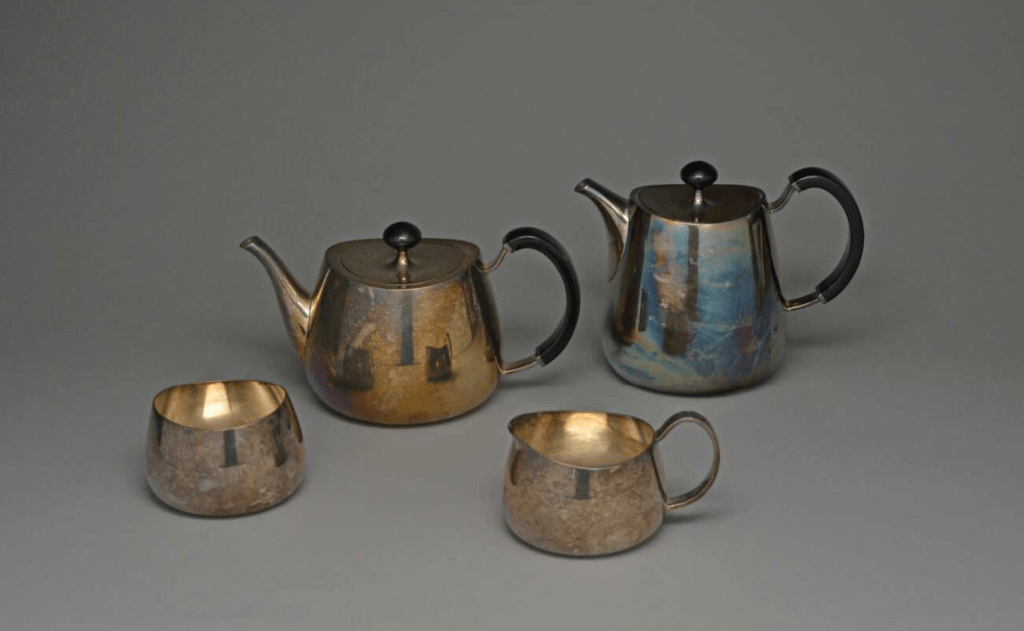
Mellor returned to Sheffield and founded a silversmithing workshop studio. He produced one-of-a-kind pieces of specially commissioned silverware. The government commissioned a range of modern silver tableware for British embassies to give Britain a more forward-looking image.

Industrial design
Mellor was motivated by the relatively new design promise of stainless steel and silversmithing. His “Symbol” cutlery was the first high-quality stainless steel cutlery to be mass-produced in the UK, beginning in 1963 at Walker & Hall’s purpose-built new factory in Bolsover, Derbyshire. The government then tasked Mellor with redesigning standard-issue cutlery for canteens, hospitals, jails, and railways, reducing the usual 11-piece place collection to five pieces and lowering prices.

Mellor designed street lighting, bus shelters, public seating, and litter bins for the Midlands engineering company Abacus Municipal. The steel lighting columns he had seen in Rome’s Borghese Gardens inspired the street lights. This was the start of a series of successful designs for use in cities, which ended a decade later with a commission from the Ministry of Transport to change the way the national traffic signal system works. At the same time, Mellor could see that the city around him was changing a lot. The Park Hill flats, one of the biggest housing projects in Europe, and the Hyde Park tower block, which was built right next to it, were two examples. Someone who grew up during the Great Depression would have been very affected by such a big change. Mellor could be critical of Sheffield, but his strong commitment to the city helped bring it firmly into the 20th century.
Retailing
Mellor started selling things to the public in 1969 when he opened his first store in London’s Sloane Square. He rented an empty space in a new building and borrowed $12,000 from his wife’s family to build and stock the shop. Soon after, in 1973, he opened his first factory in Broom Hall, a part-Tudor, a part-Georgian mansion in Sheffield that he bought and fixed up. From then on, he made knives based on his designs. In the Georgian wing, the machines were kept. Mellor liked things to be neat and clean, so the floors were swept at the end of each day.
From that point on, Mellor’s career went in a clear direction. He opened more shops in Manchester, Covent Garden, and, most notably, on the ground floor of the building he built at 22 Shad Thames, near the Design Museum in London. Part of the plan to turn Butler’s Wharf into a place for art, craft, and design, was done. Mellor was hurt by the recession and had to change his plans. He sold the building to Terence Conran, who made it his headquarters. Soon, Mellor turned his attention to something else. With the Michael Hopkins Partnership, he built a new factory on the concrete foundations of an old gasometer at Hathersage, outside Sheffield. This circular building was to win many architectural and environmental awards. It had a thick stone rim and a roof that was built inside like a bicycle wheel.
Recognition
Mellor’s success was recognised by the public when, at the age of 31, he became the youngest Royal Designer for Industry, in 1962. Two years later, he became a Fellow of the Society of Industrial Artists and Designers. With his E-Type Jaguar and forward-thinking ideas, he was seen as one of the most forward-thinking people in the design world.
He won the 1950 National Design Competition of the Design and Research Centre for Gold, Silver and Jewellery for a silver coffee set.
- 1957 Design Council Award for his Pride flatware;
- 1953 silver medal from the Royal College of Art; 1957, 1959, 1962, 1965, 1974, 1977 and other Design Council Awards;
- 1975 Architectural Heritage Year Award for conversion of Broom Hall;
- 1981 Duke of Edinburgh’s Royal Society of Arts Presidential Award for Design Management.
- In 1962, the Royal Designer for Industry was elected in 1964. fellow of the Society of Industrial Artists and Designers;
- 1979, honorary fellow of Sheffield Polytechnic;
- 1981, liveryman of the Worshipful Company of Goldsmiths; in 1981, freeman of the Cutlers’ Company;
- 1981, QBE (Order of the British Empire). He was made a trustee of the Victoria and Albert Museum in 1984.
Sources
Byars, M., & Riley, T. (2004). The design encyclopedia. Laurence King Publishing.
Spalding, F. (2009, May 08). DAVID MELLOR. The Independent
Wikipedia contributors. (2020, June 22). David Mellor (designer). In Wikipedia, The Free Encyclopedia. Retrieved 00:38, March 30, 2021, from https://en.wikipedia.org/w/index.php?title=David_Mellor_(designer)&oldid=963818
More on British Designers

British Passport a Symbol to Expolore
The British passport symbolizes identity and history, featuring a distinct navy cover and Royal Coat of Arms, providing access to…
Keep reading
Beaux Arts Gallery: A Crucible of British Modernism
The Beaux Arts Gallery was a pivotal London space for British modernism, showcasing artists like Freud and Bacon, and championing…
Keep reading
Robert Heritage: Pioneer of Mid-Century British Design
Robert Heritage, a prominent British designer, is renowned for his innovative mid-century furniture, notably the Hamilton sideboard and QE2 Restaurant…
Keep reading
Marion Mahler: Pioneer of Mid-Century British Textile Design
Marion Mahler, a pioneering textile designer, shaped mid-century modern fabric design in Britain with bold geometric abstractions, leaving a lasting…
Keep reading
Pye Model CS17: A Mid-Century Masterpiece by Robin Day
The Pye Model CS17, designed by Robin Day in 1956, showcased modern aesthetics and functionality, influencing mid-century design and becoming…
Keep reading
Flow Blue Ceramics: A Guide to This Iconic Tableware
Flow Blue ceramics are renowned for vibrant cobalt designs with blurred patterns. Produced mainly in 19th-century England, they are prized…
Keep readingSomething went wrong. Please refresh the page and/or try again.
More design articles
Discover more from Encyclopedia of Design
Subscribe to get the latest posts sent to your email.