This article forms part of the Decorative and Applied Arts Encyclopedia, a master reference hub providing a structured overview of design history, materials, movements, and practitioners.

Gerrit Thomas Rietveld (1888–1964) was a Dutch architect, cabinetmaker, and furniture designer whose work transformed the relationship between furniture, architecture, colour, and space. Best known for the Red and Blue Chair, the Zig-Zag Chair, and the Rietveld Schröder House in Utrecht, Rietveld became one of the most important figures associated with De Stijl. His designs remain central to modern furniture design because they treat chairs, tables, interiors, and buildings not as isolated objects, but as spatial constructions.
Rietveld’s importance lies in his ability to move between handcraft and abstraction. Trained in the workshop tradition, he absorbed the discipline of cabinetmaking before turning furniture into a laboratory for modern architecture. His early chairs dismantled the conventional idea of the upholstered, enclosed seat. Instead, they exposed frame, joint, plane, and colour as independent visual elements. In doing so, Rietveld gave furniture a new architectural intelligence.
Gerrit Thomas Rietveld and Modern Dutch Design
Rietveld was born in Utrecht on 24 June 1888. Between 1899 and 1906, he apprenticed in his father’s cabinetmaking workshop. This early training gave him a practical understanding of timber, joinery, proportion, and construction. From 1906 to 1911, he trained as an architectural draughtsman, and from 1911 to 1915, he attended advanced architectural courses while also beginning to establish his own independent practice.
In 1911, Rietveld opened a furniture-making business in Utrecht. At first, his work grew from the cabinetmaker’s discipline of carefully joined wooden elements. However, his intellectual direction soon shifted. He became increasingly interested in modern architecture, abstraction, and the possibility of designing objects that expressed a new social and spatial order.
Rietveld was influenced by modern architectural publications, including Frank Lloyd Wright’s Ausgeführte Bauten und Entwürfe von Frank Lloyd Wright (1910). Wright’s open planning and spatial continuity mattered to many European modernists, and Rietveld absorbed these lessons through a Dutch avant-garde lens. He translated them into objects and interiors that seemed to dissolve mass into line, plane, colour, and interval.
De Stijl, Rietveld, and Spatial Abstraction
Rietveld became associated with De Stijl through his friendship with Robert van ’t Hoff and his contact with Theo van Doesburg’s circle. Founded in 1917, De Stijl sought a universal visual language based on straight lines, rectangular planes, asymmetry, and primary colours. Although the movement is often associated with painting, especially the work of Piet Mondrian, Rietveld gave its ideas three-dimensional force.
In Rietveld’s work, De Stijl was not merely a surface style. It became a method of construction. His furniture separated components that earlier furniture traditions had concealed. Rails, supports, seats, and backs became independent elements. This approach made each object legible as a composition in space. The result was not only visual abstraction but also a new kind of structural honesty.
This distinction matters. Many designers used modernist forms as a decorative language. Rietveld used them as a way to rethink how bodies, rooms, furniture, and movement interact. His work therefore belongs not only to Dutch design history but also to the wider history of Bauhaus, Constructivist, and International Style debates about art, craft, industry, and modern life.

Red and Blue Chair by Gerrit Rietveld
The Red and Blue Chair is Rietveld’s most famous furniture design. The chair was first developed around 1918 as a largely unpainted wooden armchair. The now-iconic colour scheme of red, blue, yellow, black, and white was added later, aligning the chair more explicitly with the chromatic language of De Stijl. This colour treatment transformed the chair from a stark wooden structure into a three-dimensional diagram of modern abstraction.
The chair consists of straight timber members and flat planes arranged as if they continue beyond the object. Its back and seat do not merge into a conventional ergonomic shell. Instead, they hover within an exposed framework. This creates a sense of openness and spatial extension. The chair appears less like a solid piece of furniture and more like a small architectural system.
From a production standpoint, the Red and Blue Chair also challenged inherited assumptions about furniture making. It could be assembled from standardised wooden members rather than carved, upholstered, or ornamented components. This does not mean the chair was simple in concept. Rather, its clarity depended on precise proportion, careful alignment, and a disciplined understanding of how visual rhythm can emerge from basic construction.
The chair’s enduring power lies in its productive contradiction. It is austere and theatrical, practical and conceptual, handmade and proto-industrial. It demonstrates Rietveld’s central achievement: he made furniture behave like architecture while keeping it recognisably domestic.
Rietveld Schröder House and Truus Schröder-Schräder
Rietveld’s architectural career reached its first great landmark with the Rietveld Schröder House, completed in Utrecht in 1924. He designed the house in close collaboration with Truus Schröder-Schräder, the client, co-conceiver, and long-term occupant. Their partnership was crucial. Schröder-Schräder wanted a modern house that could support an informal, flexible, and independent way of living. Rietveld translated that ambition into one of the defining domestic works of early modern architecture.

The house is often described as the architectural manifesto of De Stijl. Its exterior presents a dynamic composition of white and grey planes, black linear elements, and selective primary colours. Rather than appearing as a closed masonry volume, it reads as an arrangement of intersecting surfaces and projecting lines. This gives the building a sense of lightness and extension, as if it were assembled from spatial relationships rather than mass.
Inside, the house deepened Rietveld’s interest in flexible space. The upper floor used movable partitions, allowing rooms to shift between open and divided configurations. Built-in furniture, sliding screens, and carefully placed colour accents made the interior a complete spatial composition. Furniture and architecture were no longer separate categories. They became parts of a single environment.
Recent scholarship has also emphasised the importance of Schröder-Schräder’s contribution. The house should not be reduced to a solitary architect’s formal experiment. It emerged from a collaboration between designer and client, and from a shared vision of modern domestic life. This makes the building especially valuable for design history because it joins abstraction, social change, gendered domestic experience, and modern spatial planning.
The Rietveld Schröder House is now recognised as a milestone of modern architecture and a UNESCO World Heritage Site. It remains one of the clearest examples of how De Stijl principles could shape an entire living environment, not merely a painting, chair, or façade.

Zig-Zag Chair and Rietveld Furniture Design
The Zig-Zag Chair, developed in the early 1930s and commonly dated to 1934, pushed Rietveld’s reduction of furniture to an extreme. It consists of four flat wooden planes: back, seat, support, and base. The design eliminates conventional legs and turns the chair into a continuous angular profile. Structurally, it appears almost impossible. Visually, it reads as a lightning-bolt geometry made functional.
The chair belongs to a broader Rietveld vocabulary of abstraction, economy, and experiment. He treated seating as a problem of planes, loads, and spatial relationships. Comfort was not ignored, but it rarely dominated the design. Instead, Rietveld asked how little material and how few gestures could still produce a functional object with architectural presence.
His 1923 Berlin Chair and related side table also show this logic. These objects use asymmetrical planes to create tension and balance. They look less like furniture derived from craft tradition and more like fragments of an abstract interior. They also demonstrate Rietveld’s interest in how furniture could direct the eye, divide space, and participate in a room’s composition.
In the late 1920s, Rietveld also experimented with bent tubular steel furniture. This placed him within a larger European modernist conversation about metal furniture, cantilever structures, and industrial production. His work intersected with debates also pursued by Mart Stam, Marcel Breuer, and Mies van der Rohe. However, Rietveld’s approach remained distinct. Where many tubular steel designs emphasised technological elegance, Rietveld continued to foreground spatial construction.

Cassina, Rietveld, and Modern Production
Rietveld’s furniture reached a wider international audience through later licensed production, particularly by Cassina. From the 1970s, Cassina’s reissues helped establish his chairs as collectible modern classics. They also clarified an important point about his work: although many pieces began in small-scale experimentation, their formal logic anticipated reproducibility.
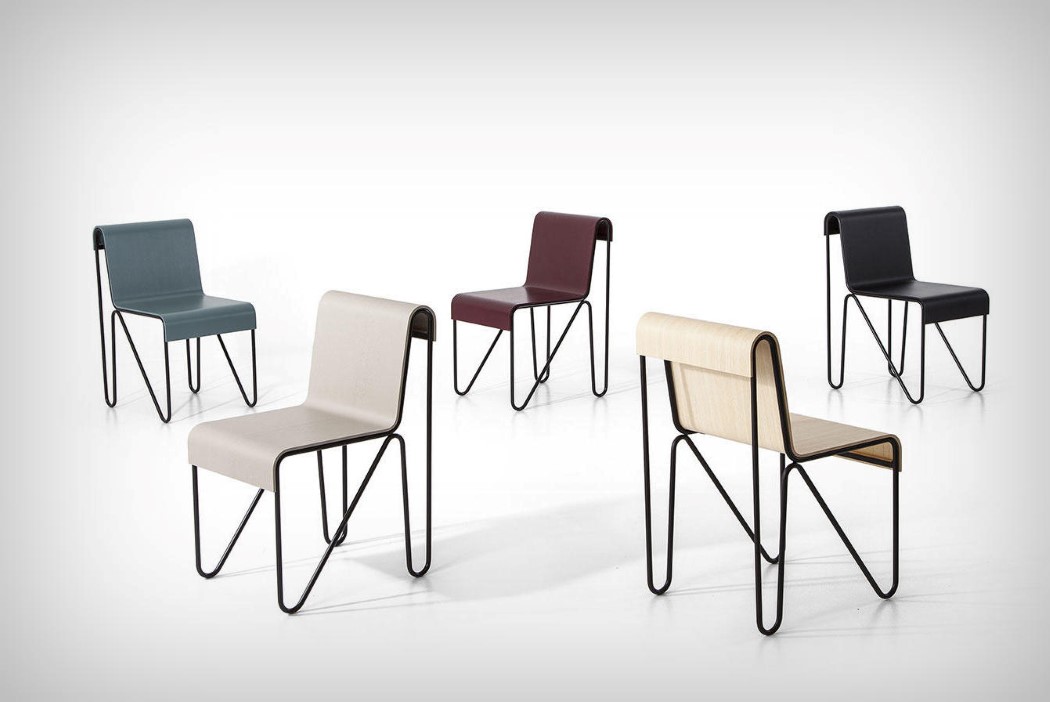
Cassina’s reissues placed Rietveld beside other canonical modern furniture designers. Yet his furniture differs from much post-war modernism. It is rarely soft, organic, or consumer-friendly in the usual sense. Instead, it retains the intellectual force of the avant-garde. The Red and Blue Chair, Zig-Zag Chair, Berlin Chair, and Beugel Chair remain demanding objects. They ask the viewer to think about how a chair is made, how it occupies space, and how furniture can communicate an idea.
Architecture After De Stijl
Although Rietveld is often framed through De Stijl, his career extended far beyond the movement’s heroic early period. He designed houses, shops, interiors, exhibition spaces, and public buildings. His work after the 1930s became more varied, sometimes more pragmatic, and often less doctrinaire than the Red and Blue Chair or Schröder House might suggest.
Among his important later works were the Erasmuslaan terrace houses in Utrecht, designed in collaboration with Truus Schröder-Schräder, and the Vreeburg Cinema in Utrecht. He also designed the Netherlands Pavilion for the Venice Biennale in 1954 and the sculpture pavilion for Sonsbeek Park in Arnhem. The latter was later reconstructed at the Kröller-Müller Museum, preserving an important example of his open, modular approach to exhibition architecture.
Rietveld was also involved in the design of the Van Gogh Museum in Amsterdam. The project began during his lifetime, although the building was completed after his death by colleagues associated with his office. This late commission reflects his recognition as a major Dutch architect, not merely as a furniture designer remembered for two early masterpieces.
Rietveld Design Analysis: Line, Plane, Colour, and Space
Rietveld’s design language can be understood through four recurring principles: line, plane, colour, and space. Line appears in the exposed rails of his chairs and in the black structural accents of the Schröder House. Plane appears in seats, backs, walls, shelves, partitions, and façades. Colour acts not as decoration but as a spatial tool, clarifying relationships between elements. Space is the final subject: the open interval between components, the room between surfaces, and the movement of the body through a designed environment.
This is why Rietveld’s furniture can appear architectural even at small scale. A chair by Rietveld is not simply a place to sit. It is a proposition about construction. His objects reveal the same questions that shape his architecture: how can mass become light? How can structure become visible? How can a room remain flexible? How can an object express modern life without relying on historical ornament?
Rietveld also challenged the boundary between applied and fine art. His chairs function, but they also behave like abstract sculpture. His interiors serve domestic life, but they also act as spatial compositions. This dual condition explains why his work remains relevant to furniture historians, architects, interior designers, museum curators, and collectors.
Rietveld and the Bauhaus
Rietveld did not belong to the Bauhaus, but his work belongs in the same broader modernist conversation. Like the Bauhaus, he addressed the relationship between craft training, modern materials, standardisation, and design for a changing society. The Bauhaus itself described modern design education as a synthesis of architecture, industrial design, craft, typography, textiles, and a “modern philosophy of design,” making Rietveld’s parallel concerns especially relevant to the wider European avant-garde.
However, Rietveld’s route to modernism was different. The Bauhaus developed through an educational institution. Rietveld emerged through cabinetmaking, private practice, and Dutch avant-garde networks. This distinction gives his work its unusual character. It combines workshop intelligence with radical abstraction. Even when his furniture appears severe, it rests on a deep knowledge of how materials meet, carry weight, and define space.
Rietveld’s influence on furniture design also intersects with Bauhaus debates about tubular steel, standardised production, and the social role of furniture. Marcel Breuer’s early furniture experiments, for example, belong to a related effort to liberate the chair from heavy upholstery and historic form. Yet Rietveld’s furniture retained a stronger relationship to spatial composition, exposed construction, and De Stijl abstraction.
Recognition and Legacy of Gerrit Rietveld
Rietveld’s work was shown in important modern design and architecture exhibitions during his lifetime and after his death. His bent tubular steel and wood furniture appeared in the 1930 Paris exhibition context, while later museum exhibitions helped reassess his role as both furniture maker and architect. The Centraal Museum in Utrecht has played a central role in preserving and interpreting his legacy, especially through the Rietveld Schröder House.
His posthumous reputation has often centred on the Red and Blue Chair and the Schröder House. These works deserve their fame, but they can also narrow our view of his career. Rietveld continued to design, build, write, teach, and experiment for decades. His later projects show an architect who remained committed to the social and spatial possibilities of modern design.
Today, Gerrit Thomas Rietveld stands as one of the essential figures in twentieth-century design history. His work links Dutch modernism, De Stijl abstraction, furniture design, domestic reform, and architectural experimentation. More importantly, it reminds us that modern design was not only a matter of style. It was a way of rethinking how objects, rooms, and lives could be constructed.
Key Takeaways: Gerrit Rietveld
- Gerrit Thomas Rietveld was a Dutch architect, cabinetmaker, and furniture designer central to De Stijl and modern design.
- The Red and Blue Chair translated De Stijl principles into three-dimensional furniture.
- The Rietveld Schröder House, designed with Truus Schröder-Schräder, remains one of the most important modern houses of the twentieth century.
- The Zig-Zag Chair reduced seating to a radical composition of four wooden planes.
- Rietveld’s furniture and architecture share a common vocabulary of line, plane, colour, structure, and flexible space.
- Later Cassina editions helped preserve and circulate Rietveld’s furniture as modern design classics.
Sources and Further Reading
Bayer, H., Gropius, W., & Gropius, I. (Eds.). (1938). Bauhaus, 1919–1928. The Museum of Modern Art.
Brown, T. M. (1958). The work of G. Rietveld, architect. A. W. Bruna & Zoon.
Byars, M., & Riley, T. (2004). The design encyclopedia. Laurence King Publishing.
Fu, X., & Dai, Z. (2019). Study on the connotation of holistic design associated with De Stijl architecture and furniture. E3S Web of Conferences.
García-Salgado, T. (2018). The Rietveld-Schröder House and the Fifth Element. Nexus Network Journal, 20, 417–435.
Kuipers, M. (2013). Rietveld and Nieuwe Zakelijkheid in architecture.
Luscombe, D. (2017). Illustrating architecture: The spatio-temporal dimension of Gerrit Rietveld’s representations of the Schröder House. The Journal of Architecture, 22, 899–932.
Overy, P. (1988). The Rietveld Schröder House.
Van Thoor, M. (2019). Colour, Form and Space.
UNESCO World Heritage Centre. (n.d.). Rietveld Schröderhuis (Rietveld Schröder House).
More on Classic Design
Learn more

Exploring the Iconic Armchair MR 20 by Mies van der Rohe
The Armchair MR 20, designed by Mies van der Rohe in 1927, exemplifies modernist elegance with innovative materials, lightweight design, and cultural significance in furniture history.

The 10 Most Popular Design Objects in the World – #7 Will Surprise You!
The post highlights ten legendary design icons, including the Eames Lounge Chair and iPhone, showcasing their cultural significance and timeless appeal across generations.

The Klismos Chair: A Timeless Icon of Classical Design
The Klismos chair, an ancient Greek design, features elegant curves and ergonomic comfort, influencing various furniture styles throughout history and remaining popular in modern interiors.

The Amsterdam School: A Decorative Architectural Movement
The Amsterdam School, an influential movement in Netherlands architecture from 1915-1930, is known for expressive design and global influence, particularly in social housing and public buildings.

Valentine Typewriter: A Cultural Icon of 1969 by Ettore Sottsass Jr. and Perry King
The Valentine Typewriter, a 1969 creation by Ettore Sottsass and Perry King for Olivetti, embodies 1960s design innovation and emotional connection, despite commercial failure.

Seagram Building Iconic New York Building
The Seagram Building in New York, designed by Mies van der Rohe and Philip Johnson, redefined modern architecture with minimalist design and urban innovations.
Related Articles
