This article forms part of the Decorative and Applied Arts Encyclopedia, a master reference hub providing a structured overview of design history, materials, movements, and practitioners.

Traditional Craftmanship
Hans J. Wegner (1914 – 2007) was a Danish furniture designer. His work and a concerted effort by several manufacturers contributed to Danish design’s international prominence in the 1950s. Organic Functionality, a modernist school emphasising Functionality, is a term used to define his style. With contributions by Poul Henningsen, Alvar Aalto, and Arne Jacobsen, this school of thought originated predominantly in Scandinavian countries.
Embed from Getty ImagesEducation & training
In 1931, he was apprenticed to a cabinetmaker in Tønder and at Teknologisk Institut. Between 1936 and 1938, he studied at the Akademiets Arkitektstole. In 1938, at the Kunsthåndvaerkerskolen, both in Copenhagen.
Biography
From 1938 to 1943, he assisted Arne Jacobsen and Erik Moller. In 1943, he founded his own office in Gentofte. From 1946 to 1953, he lectured at the Kunsthandveerkerskolen in Copenhagen.
Embed from Getty ImagesAfter meeting Johannes Hansen in 1940 or 1941, he designed several pieces for Hansen in Copenhagen, notably The Chair in 1949. Later, he created over 500 models for AP-stolen, FDB, Danish CWS, Getama, Carl Hansen, Fritz Hansen, CM Furniture, Planmobel, P.P. Mobler, and Ry Mobler. He designed the interiors of major corporations’ headquarters.

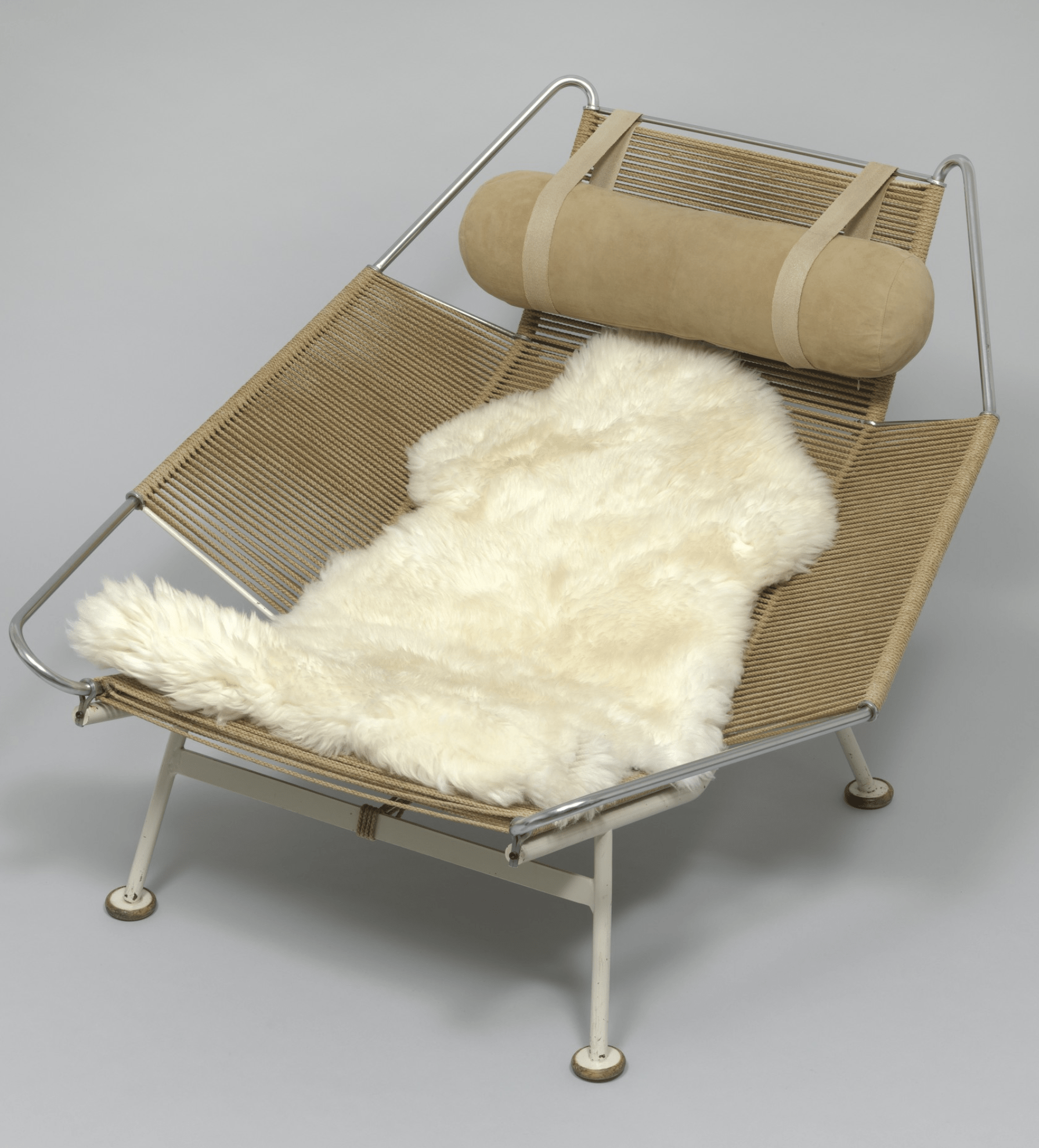
Later, he designed tubular steel furniture and the 1960 Bull chair and ottoman in leather upholstery. He is most known for his early wood pieces, several of which are still in production today. Furniture, silverware, lights, and wallpaper were among the items in his collection. Johannes Hansens Mobelsnedkeri’s Pafuglestolen (Peacock) chair from 1947 has a striking bentwood back.



Exhibitions
- Showed work at Cabinetmakers’ Guild of Copenhagen; 1949— 52, was involved in the mounting and arranging the Danish art and handicraft exhibitions.
- Received 1951 Lunning Prize; awards at the 1951 (IX) (grand prize),
- 1954 (X) (diploma of honour and gold medal), and
- 1957 (XI) (silver medal) at the Triennali di Milano;
- 1956 Eckersberg Medal;
- 1959 and 1965 Copenhagen Cabinetmakers’ Guild prize;
- 1959 Citation of Merit from Pratt Institute, Brooklyn, New York;
- 1961 and 1968 International Design Award of the American Institute of Designers;
- 1961 Prince Eugen Medal; and 1967 and
- 1968 Citation of Merit from the American Institute of Interior Designers.
- In 1959, elected Honorary Royal Designer for Industry, London. Pafuglestolen (Peacock) chair shown 1947 exhibition of the Copenhagen Cabinetmakers’ Guild and round table and chairs at its 1949 event.
Work included in
- 1948 ‘Deense Kunsthandwerk,’ Gemeente Museum, The Hague;
- 1954—57 USA ‘Design in Scandinavia’ travelling exhibition;
- 1956—59 Germany “Neue Form aus Danemark’ travelling exhibition;
- 1958 ‘Formes Scandinaves’ exhibition, Paris Musée des Arts Décoratifs;
- 1959 ‘Dansk Form og Miljo,’ Kiljevalchs Konsthall, Stockholm;
- 1960—61 USA ‘The Arts of Denmark’ travelling exhibition;
- 1962 New York’ Creative Craft in Denmark Today’; 1964 ‘New York World’s Fair’;
- 1964—65 ‘Formes Danoises’ in France;
- 1968 ‘Two Centuries of Danish Design,’ Victoria and Albert Museum, London;
- 1975—77 Eastern Europe ‘Dansk Miljo’ traveling exhibition;
- 1977 ‘Danische Formgestaltung,’ Berlin; and
- 1978 ‘Danish Design,’ Dublin.
- Work was subject of an exhibition in Zurich, 1958; at Georg Jensen, New York, 1959 and 1965; in Stockholm, 1962;
- Kunstindustrimuseet, Copenhagen, 1965; and
- Rohsska Konstslojdmuseet, Gothenburg, 1967.
Making use of wood
Wegner’s works are almost entirely constructed of wood. He was passionate about wood because he had worked with it since childhood and was trained as a cabinetmaker. Wegner used traditional construction materials like upholstery, cane, paper string, and wood. His signature style is pushing conventional ingredients to extreme limits and distillations. Wegner, unlike his predecessors, did not concentrate on materials such as fibreglass and plastics (Verner Panton), steel (Poul Kjaerholm), or polyurethane foam (Poul Kjaerholm) (Arne Jacobsen).
While Wegner liked wood, he did create certain chairs that were not practical to make with wood. Because a process for producing the huge ring from wood wasn’t accessible in 1965, Wegner created the Circle Chair (PP130) with a steel ring. However, when it was ultimately produced in 1985, PP Mobler could construct it from wood.
Embed from Getty ImagesVariations on a theme
Wegner frequently took inspiration from his designs when creating new chairs. Many of Wegner’s chairs are influenced by his earlier work. Henrik Sten Moller, a Danish art critic, titled his 1979 book on Wegner Tema Med Variationer (English: Variations on a Theme) following Wegner’s proclivity to revisit and evolve past pieces.
There are four main variations of the Chinese Chair. The early Chinese Chair series later inspired the Wishbone Chair. The Round Chair can be traced back to the Cow Horn Chair and Swivel Chair.
Traditional craftsmanship is upheld.
Wegner said of his work, “I have always wanted to make unexceptional things of an exceptionally high quality.”

Many of Wegner’s wooden chairs use traditional joinery techniques such as mortise and tenons, finger joints, and sculpted features such as armrests and seat supports. Wegner employed a mortise and tenon joint to link the arms at the centre of the backrest in the early models of the Round Chair. Wegner didn’t like how it appeared, so he wrapped the backrest in a cane to disguise what he thought was an unattractive design. Wegner later altered the design to employ a zigzag patterned finger joint to link the three components, unhappy with the compromise and the deceiving illusion that the arms and backrest were created from a single piece of wood. Using a darker wood wedge in the mortise and tenon joint in the Peacock chair emphasises the relationship of the legs to the seat. These elements highlight the steps necessary to put the furniture together and assist the user in understanding the level of craftsmanship involved in his job.
Sources
Byars, M., & Riley, T. (2004). The design encyclopedia. Laurence King Publishing.
Wikipedia contributors. (2021, April 28). Hans Wegner. In Wikipedia, The Free Encyclopedia. Retrieved 00:46, July 29, 2021, from https://en.wikipedia.org/w/index.php?title=Hans_Wegner&oldid=1020302061
More Danish Designers

Thorvald Bindesbøll: Pioneer of Danish Art Nouveau
Thorvald Bindesbøll, a key figure in Danish Art Nouveau, revolutionized decorative arts through ceramics, furniture, and graphic design, blending tradition…
Keep reading
Kay Fisker: Works and Ideas in Danish Modern Architecture
Kay Fisker, a prominent 20th-century Danish architect, innovatively merged modernism with local traditions, influencing functional design through key projects like…
Keep reading
Ebbe Gehl: Icon of Scandinavian Furniture Design
Ebbe Gehl (1943–2023) was a renowned Danish furniture designer known for blending simplicity, functionality, and traditional craftsmanship, significantly impacting modern…
Keep reading
Exploring Danish Design: The 1956 Exhibition in Germany
In 1956, Denmark showcased contemporary design in Germany through “Neue Form aus Dänemark,” promoting functionalism, simplicity, and cultural exchange while…
Keep reading
Exploring Normann Copenhagen: Design Origins and Philosophy
Origins and Philosophy Established in 1999 by Jan Andersen and Poul Madsen, Normann Copenhagen is a Danish design brand renowned…
Keep reading
Charlotte Lynggaard: Danish Jewelry Designer and Visionary
Charlotte Lynggaard, Creative Director of Ole Lynggaard Copenhagen, is renowned for her nature-inspired jewelry, emphasizing craftsmanship and versatility, celebrating 60…
Keep readingSomething went wrong. Please refresh the page and/or try again.
Related Articles

Discover more from Encyclopedia of Design
Subscribe to get the latest posts sent to your email.