This article forms part of the Decorative and Applied Arts Encyclopedia, a master reference hub providing a structured overview of design history, materials, movements, and practitioners.

The Garden Egg Chair, designed by Peter Ghyczy in 1968, is a testament to the innovative spirit of the mid-20th century. This article explores its historical context, material composition, design philosophy, and enduring legacy in applied and decorative arts.
Historical Perspective
Peter Ghyczy, a Hungarian émigré designer, created the Garden Egg Chair during his tenure at the German polyurethane factory Elastogran GmbH. The late 1960s marked a period of rapid technological advancement and experimentation in materials, particularly plastics. This era saw designers pushing the boundaries of traditional furniture design, moving towards more futuristic and functional forms.
The Garden Egg Chair was a product of its time. Designed for outdoor use, it had a folding lid to protect the interior from weather. Its innovative use of polyurethane—a material that was still relatively new in furniture manufacturing—highlighted the era’s fascination with synthetic materials and their possibilities.

Design and Materiality
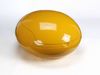
The chair is crafted from lacquered, moulded polyurethane with synthetic textile upholstery over polyurethane foam padding. Its distinctive yellow plastic shell, egg-shaped form, and hinged top make it an iconic piece of modernist design. Polyurethane’s use was revolutionary, as it allowed for the creation of complex shapes and durable structures.
However, The lacquering process proved problematic, leading to its brief production run. Initially manufactured by Elastogran in West Germany, the production was later licensed to VEB Synthesewerk Schwarzheide in East Germany. Despite its limited production from 1968 to 1971, the chair’s design and material choice impacted the design community.
Aesthetic and Functional Analysis
The Garden Egg Chair exemplifies the principles of balance, contrast, and unity in design. Its smooth, continuous form creates a balanced aesthetic that is both visually appealing and functional. The bright yellow contrasts sharply with the green of garden environments, making it a standout piece.
The chair’s ability to close completely when not in use emphasizes functionality and movement. This feature protects the upholstery from the elements, ensuring the chair’s longevity—a practical consideration that enhances its appeal.
Legacy and Influence
The Garden Egg Chair’s influence extends beyond its original production. It is a symbol of mid-20th-century innovation in materials and design. The chair has been featured in various museum collections, including the Victoria and Albert Museum in London, showcasing its significance in design history.
Contemporary designers continue to draw inspiration from Ghyczy’s work, exploring new materials and forms in furniture design. The Garden Egg Chair remains a celebrated example of how functional design can be aesthetically striking.
Conclusion
Peter Ghyczy’s Garden Egg Chair is more than just a piece of furniture; it reflects a transformative period in design history. Its innovative use of materials, unique aesthetic, and functional design make it a landmark in applied and decorative arts.
Those interested in exploring similar design icons should consider visiting museums or exhibitions featuring mid-century modern furniture. The legacy of the Garden Egg Chair continues to inspire and inform contemporary design, making it a valuable subject for study and appreciation.
Sources
Victoria and Albert Museum. (2007). Garden Egg Chair. Retrieved from https://framemark.vam.ac.uk/collections/2007BR3569/full/!100,100/0/default.jpg
More on Hungarian Design

Ilonka Karasz: A Trailblazer in Decorative Arts and Modern Design
Ilonka Karasz was a pioneering Hungarian-American designer whose diverse contributions to textiles, furniture, and illustration significantly shaped modern design in…
Keep reading
Imre Makovecz: Pioneer of Organic Architecture
Imre Makovecz, a renowned Hungarian architect, crafted organic, symbolic designs integrating nature and tradition in stark contrast to Eastern Bloc…
Keep reading
The Art of Numismatics: A Look at Paul Vincze’s Legacy
Paul Vincze was a famed coin and medal designer. Forced to flee Europe due to Nazi persecution, he made significant…
Keep reading
Pierre Vágó (1910 – 2002) Hungarian Architect and Designer
Pierre Vago was a Hungarian Architect and designer. He studied at the École Spéciale d’Architecture, Paris.
He settled in…
Keep reading
Marcel Breuer (1902 – 1981) Hungarian Architect and Industrial Designer
Marcel Breuer, a Hungarian architect and designer, pioneered tubular steel furniture with his iconic Wassily Chair, transitioning from furniture design…
Keep reading
Chaise Lounge by Marcel Breuer
Marcel Breuer designed this chaise lounge during his influential period in England (1935-37). His work for the London-based design and…
Keep readingSomething went wrong. Please refresh the page and/or try again.
Discover more from Encyclopedia of Design
Subscribe to get the latest posts sent to your email.