This article forms part of the Decorative and Applied Arts Encyclopedia, a master reference hub providing a structured overview of design history, materials, movements, and practitioners.
Yrjö Wiherheimo is a Finnish furniture designer, interior architect and educator. He is known for structurally expressive chairs and economical construction. His work uses exposed frames, thin plywood and visible springs. Carefully engineered movement addresses comfort, production and material use.
His long collaboration with Simo Heikkilä produced notable designs, including Verde 700 and Visio 200. The Victoria and Albert Museum preserves both chairs. Wiherheimo also designed public interiors, exhibition spaces and seating for contract environments. These projects extended Finnish functionalism through socially and industrially informed design.
Yrjö Wiherheimo (born 1941) is a Finnish furniture designer, interior architect, industrial designer and educator. Structural clarity and economical construction distinguish his work. He maintained a sustained interest in chairs that respond to the human body without visual or mechanical excess. From the late 1960s onwards, Wiherheimo extended Finnish functionalism through exposed frames, thin plywood planes and visible springs. He also used carefully engineered movement.

Wiherheimo designed public interiors and exhibition architecture, but experimental seating forms the best-known part of his work. He developed chairs independently and with Simo Heikkilä. Museum collections preserve several important examples. They include Verde 700 and Visio 200 at the Victoria and Albert Museum in London. These objects show that Wiherheimo used minimalism as more than an aesthetic preference. It allowed him to reconsider materials, industrial production, employment and bodily comfort.
Yrjö Wiherheimo’s Education and Early Design Career
Born in Helsinki in 1941, Wiherheimo graduated in 1967 from a Helsinki art and design institution. It later became the University of Art and Design Helsinki and now forms part of Aalto University. Some contemporary biographies describe this retrospectively as graduation from Aalto University. However, that university name did not exist in 1967.
After graduating, Wiherheimo established a design practice in Helsinki. He worked in furniture and industrial design, interior architecture, exhibition architecture and teaching. This breadth connected his furniture with his understanding of architectural space. He often designed chairs for offices, auditoriums, conference rooms and other shared environments. Domestic display was rarely their only purpose.
The Museum of Furniture Studies in Stockholm places Wiherheimo among the young, radical Finnish designers of the late 1960s. These designers did not depend on ornament or dramatic sculptural form. Instead, they reduced furniture to clearly expressed components. They also questioned conventional assumptions about upholstery, support and manufacturing.
Collaboration with Simo Heikkilä
Wiherheimo’s long collaboration with Simo Heikkilä defined much of his career. The pair worked together for several decades. Their manufacturers included Vivero in Finland and Klaessons in Sweden. Their furniture often divided a chair into a light supporting frame, thin seat and back planes, and limited upholstery. A visible mechanism or connection allowed movement.
This approach distinguished their furniture from heavily upholstered office seating. It also differed from the moulded-plastic forms associated with post-war Finnish design. Their chairs could appear austere or even skeletal. Yet this visual economy usually concealed careful ergonomic thought. Proportion, flexibility and controlled movement provided comfort without bulk.
The Aalto University Archives hold photographs and teaching slides of Visio and Visio 200. The records also show chair details and other tubular-frame furniture by Wiherheimo and Heikkilä. Kaj Franck included these experiments in his teaching slides. They therefore entered the educational record of Finnish design rather than remaining solely commercial products.
Verde 700: Furniture Design as an Industrial Programme
The Victoria and Albert Museum’s Verde 700 armchair, accession W.7-1981, provides strong evidence of Wiherheimo’s socially informed design method. The museum attributes the chair to Yrjö Wiherheimo and Simo Heikkilä. It identifies Vivero Oy as the manufacturer and dates the example to 1979–80. The chair combines tubular steel, metal springs and fittings, plastic parts, laminated birch and upholstery.

According to the V&A’s historical gallery documentation, the designers developed Verde to employ redundant workers from other industries. The production plan reused existing factories and machinery. It also kept manufacturing effort to a minimum. Available technology and labour therefore shaped the resulting form as strongly as conventional furniture-market expectations.
Verde connects Wiherheimo’s structural economy with a wider industrial context. The designers did not merely make the chair look efficient. They based it on the practical reuse of manufacturing capacity, technical skills and material processes. Its minimalism consequently carries social as well as visual meaning.
Visio 200 and the Mechanics of Responsive Sitting
Wiherheimo and Heikkilä designed the V&A’s Visio 200 armchair, accession W.8-1981, in 1979. Vivero manufactured the surviving example around 1979–80. The designers presented the Visio range at the Milan Furniture Fair in 1980. This exposure established the chair as an international example of Finnish furniture experimentation.

Visio 200 combines a tubular-steel frame with metal fittings, laminated birch seating elements and restrained cotton upholstery. Four conspicuous coil springs connect the seat and back. They allow the chair to respond to the sitter’s weight and posture. Vivero also produced a lower-backed version and offered castors for the feet.
The springs serve as both mechanism and ornament. Wiherheimo and Heikkilä did not enclose movement inside a large shell or upholstered body. Instead, they made the source of flexibility immediately visible. The chair explains itself through its construction. It appears industrial and pared back, yet its main innovation improves comfort and bodily movement.
Wiherheimo’s furniture often balances visual austerity with physical responsiveness. Visio shows that ergonomic design does not require a complex outward form. A few precisely considered components create a distinctive chair. They also give the sitter greater freedom.
Flok and Later Furniture Design
During the early 1990s, Wiherheimo and Heikkilä developed the Flok chair family with the Swedish manufacturer Klaessons. They experimented with die-cast aluminium bases. At the time, this method demanded considerable investment for Nordic contract furniture. Museum records date several Flok variants to 1991. The Museum of Furniture Studies dates the commercial launch of the developed series to 1995.
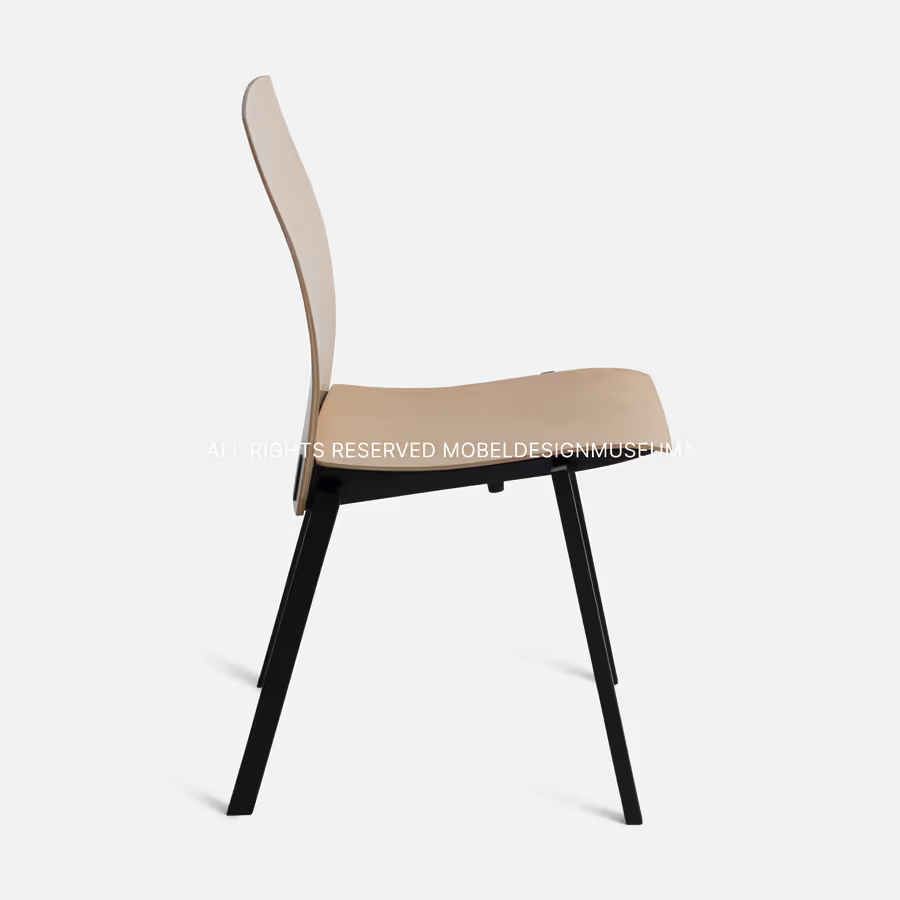
Photo: Möbeldesignmuseum/MDMThese dates describe different stages of the project rather than a contradiction. Flok combined steel, die-cast aluminium and moulded plywood. Sophisticated tooling and a prolonged development process produced its restrained appearance. The project shows that visual simplicity can require considerable technical investment.
The Museum of Furniture Studies also documents the designers’ Adam and Eva chairs from 1999. Klaessons produced their Piano chair, stool and barstool family in 2002. These later works continued their investigation of precise frames and shaped plywood. They also created furniture families that could adapt to contract interiors.
Wiherheimo collaborated with Pekka Kojo on the Bird chair for Vivero in 1993. Vivero also produced the 1993 Skin & Bones armchair. Its name directly expressed the structural reduction that characterised much of Wiherheimo’s work.
Public Interiors, Auditorium Seating and Exhibition Design
Wiherheimo applied his furniture knowledge to architectural and institutional settings. He and Heikkilä designed the Verne Theatre seating at the Finnish Science Centre Heureka in Vantaa. The centre opened in 1989. This commission brought their research into responsive, durable seating to an ambitious public building devoted to science and technology.
His practice also encompassed exhibition architecture. Rovaniemi museum documentation credits Wiherheimo with the visual and spatial design of Pohjoiset keinot. The Lapland Provincial Museum opened this permanent exhibition in December 2003. It addressed northern environments, buildings, cultural knowledge and Sámi subjects. Wiherheimo worked within a multidisciplinary museum team. He organised objects, images, interpretation and visitor movement rather than acting as the exhibition’s sole author.
These projects demonstrate the continuity between Wiherheimo’s furniture and interior architecture. In each case, design mediates between the body, information, technical requirements and a shared public space.
Teaching and the Ilmari Tapiovaara Prize
Teaching formed a substantial part of Wiherheimo’s career. Biographical sources record his teaching activity in Helsinki from the 1970s. He also held a professorial appointment at the Statens høgskole for kunsthåndverk og design in Bergen from 1987 to 1989. Yle identifies him as professor of furniture design in Helsinki from 1997 to 2007.
These accounts do not establish one uninterrupted professorial appointment. Instead, the evidence suggests that Wiherheimo taught for many years before his later full professorship in Helsinki. His furniture suited an educational context. Frame, load, material, joint and movement remained visible and open to examination.
In 2003, the University of Art and Design Helsinki awarded Wiherheimo the inaugural Ilmari Tapiovaara Prize. The award connected his career with a Finnish tradition of socially responsible furniture design. That tradition united production intelligence, material discipline and public culture.
The Significance of Yrjö Wiherheimo’s Furniture
Yrjö Wiherheimo’s contribution to Finnish design rests on a sustained investigation. He asked how little material and visual mass a functional chair requires. His work repeatedly turns construction into expression. Frames, springs, connections and separate seating planes remain legible instead of disappearing behind upholstery.
This structural honesty supports several related concerns. Thin plywood, tubular steel and restrained upholstery reduce physical and visual weight. Responsive connections permit movement without a massive mechanism. Wiherheimo and his collaborators treated production methods as part of the design problem. Verde reused existing factory capacity, while Flok required investment in die-cast aluminium tooling.
Wiherheimo belongs within Finnish functionalism, yet he complicates familiar ideas about Scandinavian furniture. His work is not primarily warm, wooden and harmonious. Instead, his designs expose tensions between rigidity and movement, industrial production and human comfort. They also balance a severe appearance with a subtle physical response. Their quietness is not passive. It results from disciplined decisions about labour, technology, material and use.
Selected Museum and Archival Sources
- Victoria and Albert Museum: Verde 700 armchair, W.7-1981
- Victoria and Albert Museum: Visio 200 armchair, W.8-1981
- Museum of Furniture Studies: Yrjö Wiherheimo
- Museum of Furniture Studies: Simo Heikkilä and Yrjö Wiherheimo
- Aalto University Archives through Finna: Visio armchair
- Archinfo: Finnish Science Centre Heureka
- Yle: attribution and biographical note concerning the Skin & Bones chair
