This article forms part of the Decorative and Applied Arts Encyclopedia, a master reference hub providing a structured overview of design history, materials, movements, and practitioners.
Richard Lindh (1929–2006) was a Finnish ceramicist and industrial designer whose career at Arabia Finland helped shape post-war domestic design. His restrained flowerpots, tableware, storage vessels and teapots emphasized practical construction, proportion and visual clarity.
Lindh also designed products beyond ceramics, including the Solifer Export moped, and held senior design and artistic leadership roles at Arabia. His work appeared in major international exhibitions and contributed to the development and promotion of Finnish modernism.

Richard Lindh (1929–2006) was a Finnish ceramicist and industrial designer whose long career at Arabia Finland helped shape the company’s modern domestic wares. Although best known for his restrained ceramic flowerpots, Lindh designed tableware, storage vessels, teapots, figurines and other household objects. He also occupied several senior positions at Arabia, combining creative work with responsibility for the manufacturer’s artistic and industrial design programmes.
Lindh belonged to the generation that established Finland as an international centre of modern design during the 1950s and 1960s. His objects rarely pursued spectacle. Instead, they brought carefully controlled proportions, practical construction and visual clarity into everyday interiors.
Richard Lindh’s Education in Helsinki
Richard Lindh was born in Helsinki in 1929. He attended Helsinki’s Free Art School in 1950–1951 before studying ceramics at the Taideteollinen oppilaitos, or Institute of Industrial Arts, generally dated to 1951–1954.
The institution is sometimes identified in English-language references by its later name, the University of Art and Design Helsinki. However, Aalto University’s institutional history confirms that it was known as the Taideteollinen oppilaitos from 1949 and did not become the Taideteollinen korkeakoulu until 1973. It subsequently became part of Aalto University.
Lindh’s education coincided with a decisive period in Finnish applied art. Post-war reconstruction increased demand for practical, well-made household goods, while exhibitions such as the Milan Triennials brought Finnish glass, ceramics, textiles and furniture to an international audience. Designers were encouraged to connect artistic experimentation with the requirements of serial production.
Richard and Francesca Lindh’s Helsinki Studio
While still establishing his career, Richard Lindh opened a ceramics studio in Helsinki with his fellow ceramicist and first wife, Francesca Mascitti-Lindh. Active from approximately 1953 to 1955, the workshop concentrated principally on functional ceramics.
Their early collaboration is important because it complicates the conventional separation between individual authorship and industrial design. Richard and Francesca Lindh developed objects together before both joined Arabia in 1955. Their best-documented collaborative design is the Double Teapot of 1956, a two-part glazed earthenware vessel now held by the Museum of Modern Art in New York.
The teapot combines two stacked forms into a compact vertical composition. Its dark glaze and rounded volumes give it the presence of a studio object, while its modular construction reflects the practical and spatial concerns of post-war domestic design. MoMA identifies both Francesca and Richard Lindh as its designers and Arabia, Wärtsilä Ab, as its manufacturer.
Richard Lindh at Arabia
Richard Lindh joined Arabia’s art department in Helsinki in 1955 and remained with the company until 1989. His career therefore extended across more than three decades of significant technological, commercial and stylistic change.
Sources differ slightly over the dates and titles of his successive appointments. The most consistent chronology places him in charge of Arabia’s applied or industrial arts department from approximately 1959 or 1960, followed by leadership of the product design department from 1964. From 1973, he held an artistic directorship or leadership role within the art department. Later responsibilities reportedly included the company’s giftware and direct-marketing operations.
These administrative duties reduced the time available for Lindh’s independent creative work. Nevertheless, his influence extended beyond the objects carrying his name. As a departmental head and artistic director, he participated in decisions about product development, manufacturing and the relationship between Arabia’s studio artists and its industrial production.
Arabia offered designers an unusually productive environment. Art objects, experimental ceramics and mass-produced household goods could be developed within the same organisation. Lindh worked alongside figures associated with the international reputation of Finnish ceramics, including Kaj Franck, Birger Kaipiainen, Ulla Procopé, Raija Uosikkinen and his wives Francesca Mascitti-Lindh and, later, ceramic designer Inkeri Leivo.
Richard Lindh’s Arabia Flowerpots
Richard Lindh’s most recognisable Arabia designs are his ceramic flowerpots. He began developing planters during the late 1950s, gradually replacing conventional decorative forms with simpler geometric profiles.
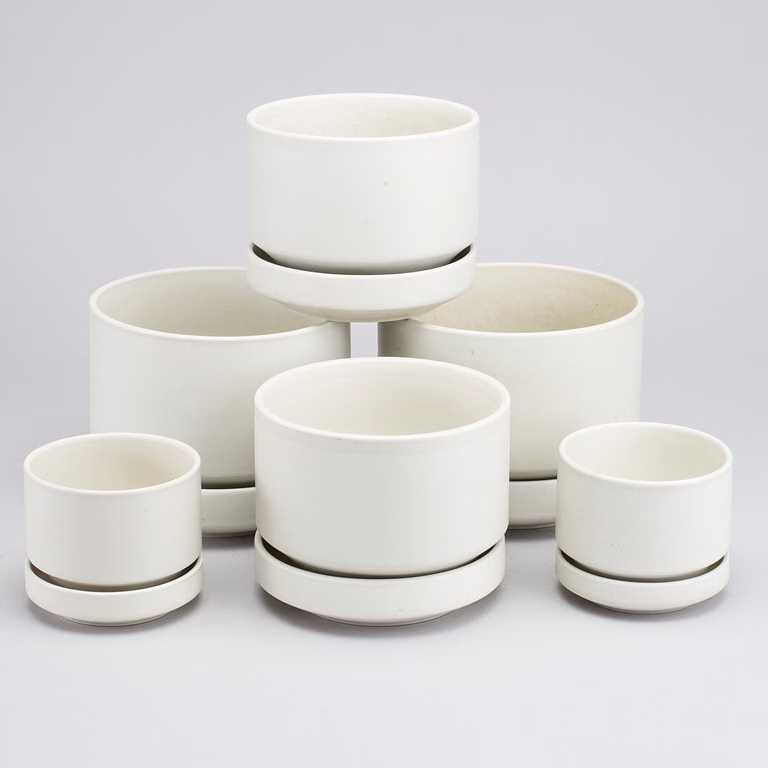
The SL series, introduced around 1959, included round pots with clean, gently tapering bodies. The rectangular LB designs followed during the early 1960s. These objects were visually quiet but carefully resolved. Their proportions allowed the ceramic container to complement a plant without competing with it, while integrated saucers and practical forms addressed the requirements of everyday use.
The SN1 series became particularly successful. Manufactured in hard faience from 1964 until 1985, it remained in production for more than two decades. The long production period helps explain why examples continue to appear in Finnish homes and vintage collections.
Lindh’s flowerpots demonstrate how modest household objects can embody a wider design philosophy. Their character comes from profile, surface, colour and proportion rather than applied ornament. They belong to the modern interior without relying on novelty, which has allowed them to remain visually relevant long after their original manufacture.
Tableware, Storage Vessels and Decorative Ceramics
Although flowerpots dominate Richard Lindh’s present reputation, his work for Arabia was considerably broader. He designed individual vessels and tableware forms in faience, porcelain, stoneware and chamotte. His production included cups, jugs, teapots, storage containers, dinner services and small animal figures.
Museum records document Lindh’s contribution to Arabia’s tableware systems. A Finnish museum record, for example, attributes the DG cup model, produced from 1965 to 1973, to him. Another identifies his C-model cup, manufactured between 1967 and 1974. Decorations could be supplied by other Arabia artists, allowing a standard form to support several visual identities. This division between form design and surface decoration was central to modern ceramic manufacture.
Lindh also designed storage jars intended to occupy minimal space. Their compact shapes express the same concern for utility found in his planters. Decorative versions were produced with patterns by Arabia artist Esteri Tomula, illustrating the collaborative structure of the factory’s design process.
The Lady dinner service, produced from 1967 to 1974, extended his approach across a coordinated group of plates and serving vessels. Even Lindh’s smaller decorative objects, including stoneware bear figures, retained his preference for simplified mass, controlled silhouettes and economical detail.
Industrial Design Beyond Ceramics
Richard Lindh was not restricted to ceramic design. A motorcycling enthusiast, he designed the Solifer Export moped in 1958. It has been described as the first moped designed and manufactured entirely in Finland.

The project demonstrated Lindh’s ability to transfer his understanding of proportion and practical construction to a very different industrial context. It also led to commissions involving products such as taps, architectural components, caravans and oil-burning stoves.
This wider practice places Lindh within the interdisciplinary culture of Finnish industrial design. His importance rests not only on the visual character of individual Arabia objects but also on his capacity to work across materials, production systems and product categories.
International Exhibitions and Recognition
Richard Lindh’s work appeared during the period when Finnish design was receiving sustained international attention. Biographical and catalogue sources record his inclusion in the H55 housing and applied-arts exhibition at Helsingborg, Sweden, in 1955. H55 was a major international exhibition devoted to housing, interiors and contemporary industrial art.

His work was also associated with the eleventh and twelfth Milan Triennials in 1957 and 1960. A photograph preserved in the archives of the Triennale di Milano documents ceramic-and-wood cigarette containers designed by Lindh in the Finnish section of the 1957 exhibition.
Further international exposure came through the travelling Finlandia exhibition presented in Zürich, Amsterdam and London in 1961. These exhibitions situated his work within the wider international promotion of Finnish modernism.
Some secondary biographies state that Richard Lindh received first prize in a competition at New York’s Museum of Contemporary Crafts. The surviving accounts are inconsistent, however, and several sources specifically attribute the 1956 prize to Francesca Mascitti-Lindh. Because their early work was frequently collaborative, the award should not be presented as Richard Lindh’s individual achievement without additional documentary evidence.
Lindh received the Finnish State Design Prize in 1970, recognising his contribution to the country’s applied arts and industrial design.
Richard Lindh’s Legacy in Finnish Ceramic Design
Richard Lindh retired from Arabia in 1989 and died in Helsinki in 2006. His career connected the intimate scale of studio pottery with the organisational demands of a major ceramic manufacturer.
His designs embody an understated form of Finnish modernism. They are functional without being anonymous and refined without appearing precious. The flowerpots, cups, storage jars and tableware depend on proportion and material rather than elaborate decoration. Consequently, they remain compatible with interiors far removed from those in which they first appeared.
Lindh’s managerial work was equally significant. Through his leadership of Arabia’s design departments, he helped sustain an environment in which artistic ceramics and industrial production could inform one another. His contribution is therefore found both in identifiable objects and in the broader design culture that produced them.
Today, Richard Lindh’s Arabia flowerpots are among his most collected works. Yet his career deserves a wider interpretation. He was a ceramicist, product designer and design director whose work ranged from hand-developed vessels to tableware systems and motor vehicles. Together, these projects reveal a designer committed to making modern form useful, durable and accessible.
References
- Aalto University. “Builders of the Future.”
- Lombardia Beni Culturali. “XI Triennale—Sezione della Finlandia—Portasigarette in ceramica e legno—Richard Lindh.”
- McFadden, David Revere, ed. Scandinavian Modern Design, 1880–1980. New York: Harry N. Abrams, 1982.
- Museum of Modern Art. “Francesca Lindh, Richard Lindh: Double Teapot, 1956.”
- Nevaluoma, Kari-Otso. “Arabia’s Richard Lindh and His Coveted Flowerpots.” Kotona Living, 2025.
- Opie, Jennifer Hawkins. Scandinavia: Ceramics and Glass in the Twentieth Century. New York: Rizzoli, 1990.
