This article forms part of the Decorative and Applied Arts Encyclopedia, a master reference hub providing a structured overview of design history, materials, movements, and practitioners.

Gerrit Thomas Rietveld was a Dutch architect, furniture maker, and designer. He was born in Utrecht. Probably the most innovative and avant-garde designer of his time, Rietveld’s furniture designs were ground-breaking visually and from a production standpoint. Even 90 years later, his chairs look as fascinating as they did in the 20s and 30s.
Education
Between 1899 and 1906, he apprenticed in his father’s cabinetmaking workshop in Utrecht.
1906-11, trained as an architectural draftsman.
Biography
Rietveld was greatly influenced by Frank Lloyd Wright’s portfolio Ausgeführte Bauten und Entwürfe von Frank Lloyd Wright (1910).
In 1911, he opened his own furniture-making business in Utrecht.
1911-15, he took advanced architectural courses and built several buildings.
Rietveld was associated with the De Stijl group from its formation in 1917 by Theo van Doesburg through his friendship with Robert van t’Hoff and was a member until 1931. The association inspired him to pursue furniture design, conceived as spatial composition with little thought for comfort.

Partnership with Truus Schroder-Schrader
His architecture career began with the 1924 Schroder House, Utrecht, which he designed with Truus Schroder-Schrader, a De Stijl member with whom he collaborated from 1921. In partnership with her, Rietveld kept a studio in the house until 1932 and lived there from 1958. Their projects included the 1934 terrace of houses in the Erasmuslaan in Utrecht and the 1936 Vreeburg Cinema in Utrecht.
Rietveld also designed the 1954 Netherlands Pavilion at the Biennale di Venezia, the 1954 sculpture pavilion in the Sonsbeek Park in Arnheim, and the 1963-72 Rijkmuseum Vincent van Gogh (with J. van Dillen and J. van Tricht) in Amsterdam.

Furniture
In 1927, Rietveld designed a diagonal bent tubular steel chair.
Because of Cassina’s reproductions in the 1980s, his best-known work became the 1918 Red Blue Chair, incorporating 15 lintels, which explored Piet Mondrian’s colour use. However, it was first produced without colour in 1917.

Along with this skeletal chair, his 1923 Berlin chair, end table, and the 1934 Zig-Zag chair became icons of 20th-century design.
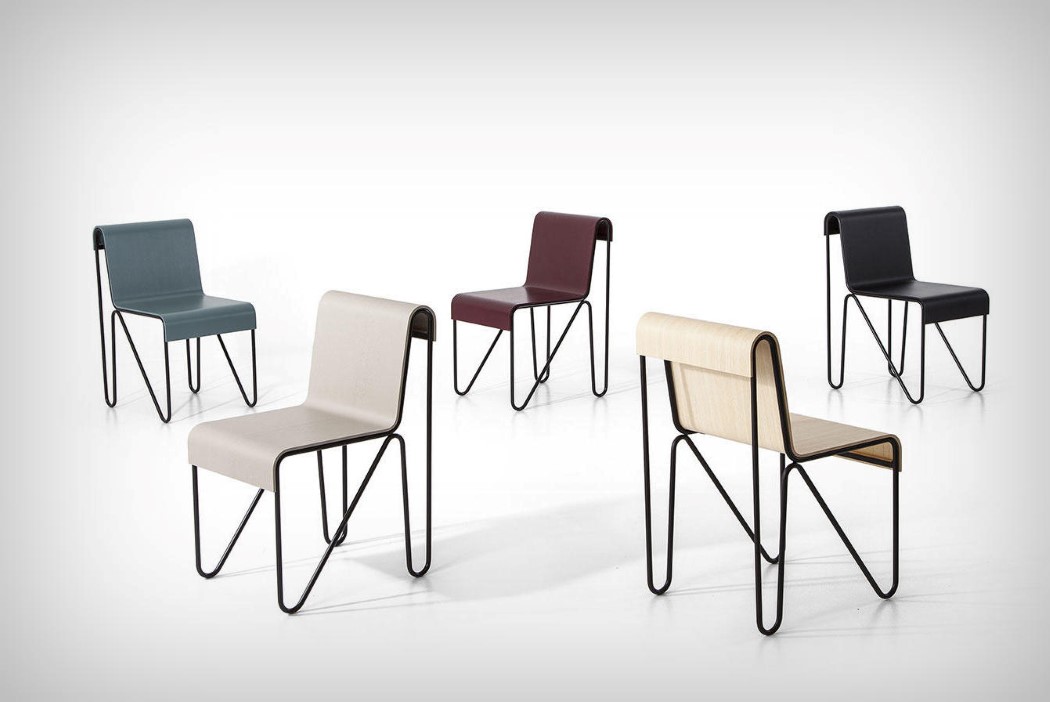
His furniture inspired Marcel Breuer at the Bauhaus in the early 1920s. His furniture could be seen as abstract sculptural objects with a practical function.
Like the Futurists, Rietveld preferred houses with scaffolding around them; in his Red Blue chair, the scaffolding’ holds the seat and back in place.
One of his chair models of the late 1920s was made from clamped scaffolding poles. Rietveld worked with cardboard, making models to develop his ideas rather than sketching them on paper. Though he worked chiefly in wood, he also produced furniture in bent metal tubing.
Recognition
His bent tubular steel and wood easy chairs and tables were shown at the 1930 Paris exhibition. His work was the subject of the 1983 Rietveld als Meubelmaker, Wonen met Experimenten’ exhibition at the Central Museum in Utrecht, and included in the 1986 ‘Der Kragstuhl’ exhibition at the Stuhlmuseum Burg Beverungen in Berlin. First major posthumous exhibition at Centre Georges Pompidou, Paris, 23 June-27 Sept. 1993.
Sources
Byars, M., & Riley, T. (2004). The design encyclopedia. Laurence King Publishing.
More on Classic Design

Exploring the Iconic Armchair MR 20 by Mies van der Rohe
The Armchair MR 20, designed by Mies van der Rohe in 1927, exemplifies modernist elegance with innovative materials, lightweight design, and cultural significance in furniture history.
Keep reading
The 10 Most Popular Design Objects in the World – #7 Will Surprise You!
The post highlights ten legendary design icons, including the Eames Lounge Chair and iPhone, showcasing their cultural significance and timeless appeal across generations.
Keep reading
The Amsterdam School: A Decorative Architectural Movement
The Amsterdam School, an influential movement in Netherlands architecture from 1915-1930, is known for expressive design and global influence, particularly in social housing and public buildings.
Keep reading
Valentine Typewriter: A Cultural Icon of 1969 by Ettore Sottsass Jr. and Perry King
The Valentine Typewriter, a 1969 creation by Ettore Sottsass and Perry King for Olivetti, embodies 1960s design innovation and emotional connection, despite commercial failure.
Keep reading
Seagram Building Iconic New York Building
The Seagram Building in New York, designed by Mies van der Rohe and Philip Johnson, redefined modern architecture with minimalist design and urban innovations.
Keep reading
Lava Lamps Retro Cool Mesmerizing History
The lava lamp, invented in 1963, embodies psychedelic and retro aesthetics, symbolizing counterculture movements. Its enduring appeal and scientific intrigue make it a beloved cultural icon today.
Keep readingSomething went wrong. Please refresh the page and/or try again.
Related Articles
Discover more from Encyclopedia of Design
Subscribe to get the latest posts sent to your email.