This article forms part of the Decorative and Applied Arts Encyclopedia, a master reference hub providing a structured overview of design history, materials, movements, and practitioners.


Henning Koppel (1918 – 1981) was a Danish artist and designer. He is most known for his work for Georg Jensen after World War II. He also designed porcelain (Bing & Grøndahl, glass (Holmegaard) and lamps (Louis Poulsen & Co). Koppel’s background was not in design but in fine art. His work was known to emphasise form and not functionality. This has been seen as a sculptural quality in his work.
Education
Koppel was born on May 8 1918, in Copenhagen, the son of an editor and later editor-in-chief of Politiken Valdemar Koppel (1867–1949) and translator Elise Jørgensen (1880–1974). He graduated from Øregårds Gymnasium in 1934 and then studied first under professor Einar Utzon-Frank at the Royal Danish Academy of Fine Arts’s School of Sculpture in 1936–37 and then at Académie Ranson in Paris in 1938.
Sculpture
Koppel debuted as a sculptor at the Artists’ Autumn Exhibition in 1935 with an expressive portrait bust. He was also represented with drawings in several exhibitions. His best works as a sculptor are the busts of Valdemar and Jytte Koppel (1938 and 1942, both in black granite) and Tora Nordstrom Bonnier and Karl-Adam Bonnier (1944).
Design
As a result of his Jewish background, Koppel had to seek refuge in Sweden during World War II. In Stockholm, where he resided from 1943-44, he attracted considerable attention as a jewellery designer for Svenskt Tenn.
Back in Denmark in 1945, he obtained a contract with Georg Jensen, a collaboration that lasted the rest of his life. The silverware he designed for Geog Jensen was “fluid, sinuous, and beautiful before it was functional.”
His work was rewarded with gold medals on three Milan Triennials (1951, 1954 and 1957). His Georg Jensen designs included hollowwares, jewellery, and flatware patterns such as Caravel (silver, 1957) and New York (steel, 1963).[3]
In 1961, Koppel also began to work for Bing & Grøndahl. His designs for the company included both coffee and tea sets, flatware patterns and several jugs and serving dishes.
He has also designed glassware for Holmegaard and Orrefors. In 1963, he won 1st prize in a competition to create a new series of stamps for Post Danmark, but his design proposal was never realised.

Recognition
He has received numerous awards, including the 1953 Lunning Prize (with Tias Eckhoff); gold medals at 1951 (IX), 1954 (X), and 1957 (XI) Triennali di Milano; and the 1963 International Design Award (Jensen tableware), American Institute of Designers. Work (silver) shown at 1954—57 USA’ Design in Sctravellingia’ travelling exhibition; 1956—59 ‘Neue Form aus Danemark’ travelling German exhibition; 1958 ‘Formes Scandinaves,’ Paris Musée des Arts Décoratifs; 1960—61 ‘The Arts of Denmark’ travelling USA exhibition; 1975′ Adventures in Swedish Glass,’ Australia. He was a featured designer at the 1966′ Centenary Exhibition,’ Goldsmiths Hall, London.


Sources
Byars, M., & Riley, T. (2004). The design encyclopedia. Laurence King Publishing. https://amzn.to/3ElmSlL
Hestad, M. (2016). Branding and Product Design: An Integrated Perspective. United Kingdom: Taylor & Francis. https://amzn.to/3AoJi6f
Miller, J. (2018). Miller’s Mid-Century Modern: Living with Mid-Century Modern Design. United Kingdom: Octopus. https://amzn.to/3AeT230
Wikipedia contributors. (2021, November 12). Henning Koppel. In Wikipedia, The Free Encyclopedia. Retrieved 02:10, December 30, 2021, from https://en.wikipedia.org/w/index.php?title=Henning_Koppel&oldid=1054867740
More About Svenskt Tenn
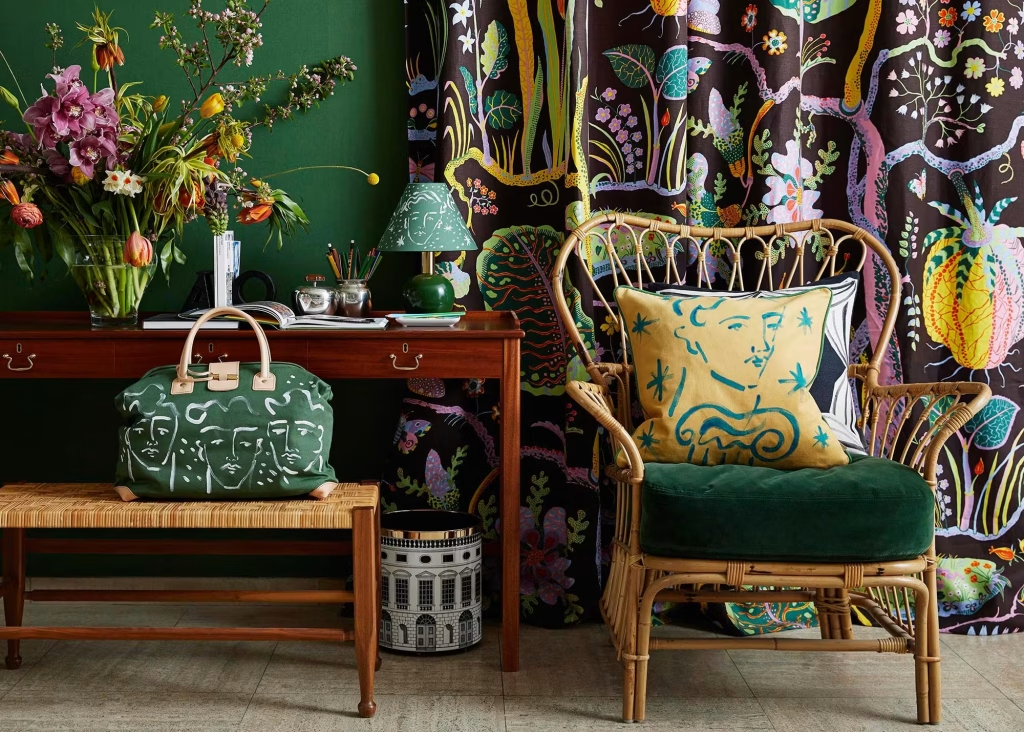
Svenskt Tenn, founded in 1924 by Estrid Ericson, is a renowned Swedish interior design company celebrated for its distinctive blend of functionalism and vibrant aesthetics. Originally focusing on pewter objects, the company expanded into furniture and textiles, significantly influencing the “Swedish Modern” style. (Wikipedia)
Historical Perspective
In 1934, Ericson collaborated with Austrian architect and designer Josef Frank, who fled to Sweden due to the rise of Nazism. This partnership led to a departure from strict functionalism, embracing more organic forms and bold patterns. Their work gained international acclaim, notably at the 1937 Paris and 1939 New York World Expositions, where their innovative designs challenged contemporary norms. (Wikipedia)
Design Philosophy and Visual Aesthetics
Svenskt Tenn’s design philosophy emphasizes a harmonious balance between form and function, infused with playful elements. Their creations often feature vibrant colour palettes and intricate patterns, reflecting a commitment to both aesthetic appeal and practicality. This approach aligns with the principles of balance, contrast, and unity in design, creating both cohesive and dynamic spaces.
Legacy and Influence
Today, Svenskt Tenn remains a testament to timeless design, with many of Frank’s furniture pieces and textiles still in production. The company’s commitment to craftsmanship and sustainability inspires designers and enthusiasts alike. In 2024, Svenskt Tenn celebrated its 100th anniversary with an exhibition at Stockholm’s Liljevalchs Art Gallery, highlighting its enduring impact on global design. (Vogue)
Svenskt Tenn’s journey underscores the importance of adaptability and innovation in design. By embracing diverse influences and challenging traditional norms, the company has crafted a unique aesthetic that resonates across generations. This legacy invites us to consider how blending functionality with artistic expression can create enduring and meaningful designs.
More Danish Designers

Thorvald Bindesbøll: Pioneer of Danish Art Nouveau
Thorvald Bindesbøll, a key figure in Danish Art Nouveau, revolutionized decorative arts through ceramics, furniture, and graphic design, blending tradition…
Keep reading
Kay Fisker: Works and Ideas in Danish Modern Architecture
Kay Fisker, a prominent 20th-century Danish architect, innovatively merged modernism with local traditions, influencing functional design through key projects like…
Keep reading
Ebbe Gehl: Icon of Scandinavian Furniture Design
Ebbe Gehl (1943–2023) was a renowned Danish furniture designer known for blending simplicity, functionality, and traditional craftsmanship, significantly impacting modern…
Keep reading
Exploring Danish Design: The 1956 Exhibition in Germany
In 1956, Denmark showcased contemporary design in Germany through “Neue Form aus Dänemark,” promoting functionalism, simplicity, and cultural exchange while…
Keep reading
Exploring Normann Copenhagen: Design Origins and Philosophy
Origins and Philosophy Established in 1999 by Jan Andersen and Poul Madsen, Normann Copenhagen is a Danish design brand renowned…
Keep reading
Charlotte Lynggaard: Danish Jewelry Designer and Visionary
Charlotte Lynggaard, Creative Director of Ole Lynggaard Copenhagen, is renowned for her nature-inspired jewelry, emphasizing craftsmanship and versatility, celebrating 60…
Keep readingSomething went wrong. Please refresh the page and/or try again.
Related Articles
Discover more from Encyclopedia of Design
Subscribe to get the latest posts sent to your email.