This article forms part of the Decorative and Applied Arts Encyclopedia, a master reference hub providing a structured overview of design history, materials, movements, and practitioners.

Between 1890 and 1914, the École de Nancy, or Nancy School, was a group of Art Nouveau artisans and designers based in Nancy, France. The furniture designer Louis Majorelle, the cabinet maker and glass artist Jacques Grüber, the glass and furniture designer Émile Gallé, and the Daum crystal factory were important contributors. Their work was primarily influenced by the region’s floral and vegetation types. The group’s mission was to create ordinary objects in a series, such as furniture, glassware, and pottery, with fine craftsmanship and unique styles, thus making art objects accessible to the general public.
History
The Nancy School arose from dramatic events in Lorraine’s history after becoming a French province in 1776. Following France’s defeat in the Franco-Prussian War in 1870, Alsace and a significant portion of Lorraine were ceded to the German Empire, but Nancy remained within France. The split resulted from a considerable migration of French musicians, artisans, teachers, and businesspeople from German-occupied Lorraine to Nancy. Nancy’s population grew to 100,000 people, making it the largest city in Eastern France. It became the region’s economic, political, and cultural hub. Textiles, leather, beer, glass, and ceramics were all manufactured in the city. It had excellent transportation links to Paris and the rest of France because of its strategic location along the German border.
A community of young craftsmen in the city formally founded the Nancy School in 1901. Since 1894, when a group of artists formed the Lorraine Society of Decorative Arts, it has existed informally. Émile Gallé was in charge of the new group. The group had a successful experience at the 1900 Universal Exposition in Paris. Gallé emphasised the importance of artists returning to nature as their primary source of inspiration.
The school’s formal objectives were released on February 13, 1901, and it was stated that it was “a provincial alliance of the arts industries.” It was to organise exhibitions and artist workshops, promote creative education reform, and adapt the arts to modern production methods. The School’s manifesto stated that the primary requirement of the work produced should be usefulness and that it should be modelled as closely as possible after Lorraine’s natural flora, especially ginkgo, pennywort, giant hogweed, water lily, thistle, gourd, and creatures such as dragonflies. Émile Gallé, Louis Majorelle, Jean-Antonin Daum, and furniture designer Eugène Vallin were among the founding committee members.
Glassware and crystal
Nancy was especially well-known for its work in glass and crystal. In 1878, glassmaker Jean Daum immigrated to France and founded his studio, Daum Glass, which was passed on to his two sons, Antonin and Auguste Daum. They were instrumental in the company’s transition to Art Nouveau. “To introduce industrially the true principles of decorative art,” the Daum brothers said at the end of the 1880s.
Their approach was to create both series and one-of-a-kind pieces, and they adapted well to the modern electric light bulb technology. The vases and lamps usually featured simplistic designs based on plants or vegetables and monochrome or richly varied colours from several layers of glass inside the lamp.


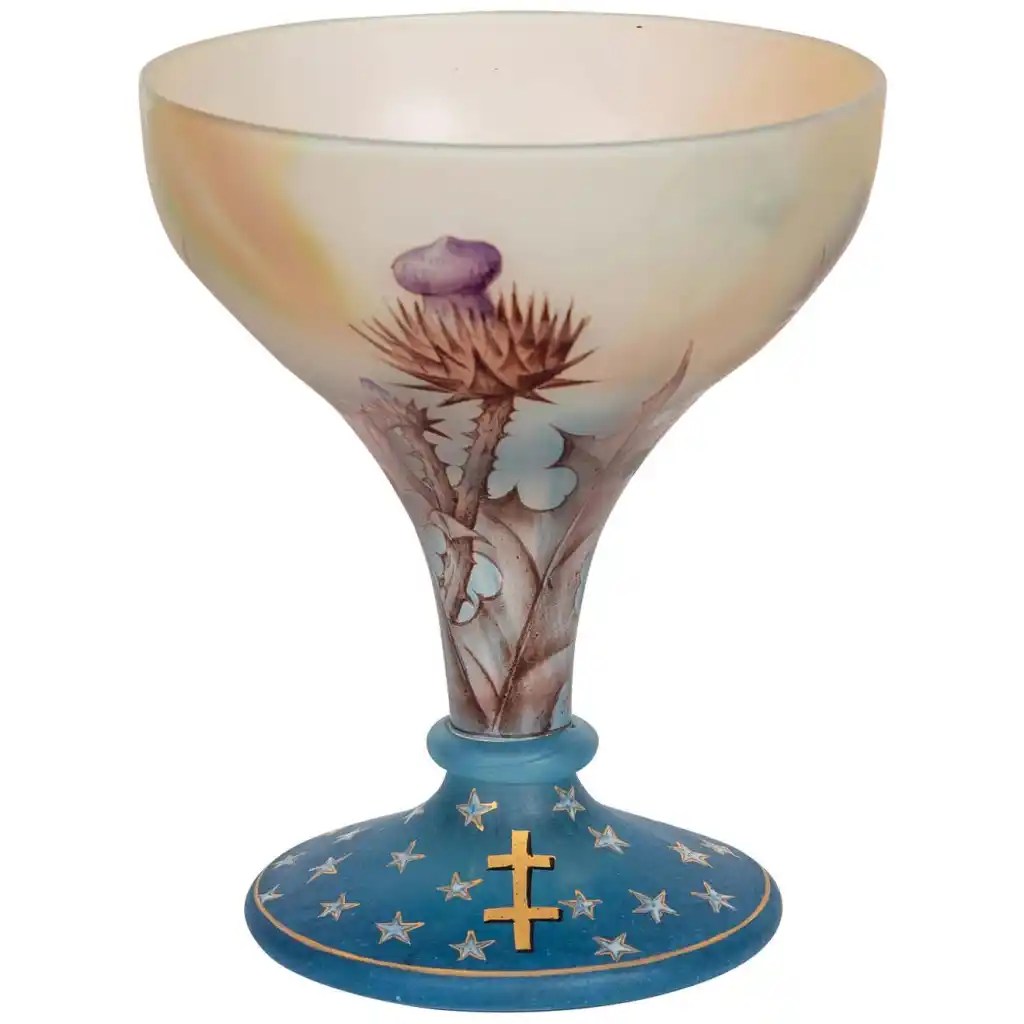
Émile Gallé was another vital figure in Nancy’s glass art scene. Gallé’s work was diverse, with various colours, patterns, and materials, such as glass, ceramics, crystal, porcelain, and faience. He experimented with various materials. A method is known as glass marqueterie. He inserted coloured glass, powdered glass, silver, or gold into hot glass. He was also fascinated by Japanese art, and he borrowed techniques from it to achieve his ambitions. The critic Henri Franz wrote of Gallé in 1897 that while he used Japanese techniques, “nothing is farther from Japanese art. He only borrowed the expressions of Japanese art and remade them with skill and taste. Nature offered him an inexhaustible source of inspiration. When Gallé represented a plant, his immense artistic sensibility reduced it to its essence.”
Furniture
Another significant art and industry in Nancy was furniture design and manufacture. Many skilled artisans, many of whom came from German-controlled Alsace, lived in the region. Artists in other crafts, such as glassware and textiles, collaborated closely with the furniture designers.
Louis Majorelle was the most influential figure in Nancy’s furniture. However, when his father died, he had planned to be a painter and artist. He took over the family business of making furniture and ceramics. He was a founding member of the Nancy School and was heavily inspired by Émile Gallé’s theories. With the School’s ideas in mind, he shifted his company’s furniture production away from conventional designs and towards Art Nouveau.


Many of Majorelle’s works from the 1890s were modelled by his collaborators Jacques Grüber and Camille Gauthier. Majorelle often collaborated with Émile Gallé, a Nancy glass artist. Lucien Weissemburger, a well-known Nancy architect, joined his firm in 1898. However, he began to create his designs. He crafted not only woodwork but also bronze and other metal fittings, decorations, and decorative ironwork. The elegant Art Nouveau stairway railing of the Galeries Lafayette Department Store in Paris was one of his ironwork creations (1900).
His work was a huge hit at the 1900 Universal Exposition in Paris. He displayed finely crafted furniture made of dark walnut, mahogany, snakewood, and hazelwood, which contrasted with gilded bronze and hammered copper ornaments influenced by natural forms such as water lilies during this period. His water lily bed (1902–03), which is now on display at the Musée d’Orsay in Paris, is a classic example of the theme. Another example is the Orchid Desk (1903–05), made of snakewood and adorned with sculpted and chiselled bronze and copper.
Stained Glass
In Nancy, stained glass was another Art Nouveau speciality. Jacques Grüber, Émile André, and Eugène Vallin were the most well-known artists, and they often collaborated on projects with Majorelle, Daum, and the other Nancy designers.

Architecture
Majorelle and other School members designed and decorated various Art Nouveau houses and buildings in Nancy. The Villa Majorelle, Louis Majorelle’s home, is the most well-known. It was designed by the young Paris architect Henri Sauvage between 1901 and 1902, at the height of the Art Nouveau era, with furniture and decoration by members of the School of Nancy. The majority of the furnishings were sold and scattered after Majorelle’s death. The Musée de l’École de Nancy now houses some of the items, including the bedroom furniture.
Sources
Byars, M., & Riley, T. (2004). The design encyclopedia. Laurence King Publishing.
Wikipedia contributors. (2021, April 20). Nancy School. In Wikipedia, The Free Encyclopedia. Retrieved 20:25, May 12, 2021, from https://en.wikipedia.org/w/index.php?title=Nancy_School&oldid=1018930854
More Design Associations and Organisations

Biennale di Venezia: A Legacy in Art and Design
The Biennale di Venezia, established in 1895, has evolved into a key multidisciplinary event, shaping applied arts and design trends while bridging historical craftsmanship with contemporary innovation.
Keep reading
Exploring Canadian Industrial Design: ACID and Its Impact
The Association of Canadian Industrial Designers (ACID) promotes industrial design, offering various membership tiers with benefits such as networking, advocacy, and professional development since 1948.
Keep reading
Unlock Creative Potential: Insights from Adobe
The Adobe Design Blog offers insights into design innovation, exploring AI tools, typography, user experience, and inspiring stories to empower creatives in their journeys.
Keep reading
Urban Design Forum: Shaping a Just and Thriving New York City
The Urban Design Forum drives urban innovation in New York City, promoting social justice and collaboration among civic leaders to create inclusive, affordable, and vibrant neighborhoods for all.
Keep reading
The Seven and Five Society: A Radical Shift in British Modern Art
The Seven and Five Society, formed in 1919, evolved from traditional to abstract art, led by influential figures like Ben Nicholson, marking a pivotal shift in British modernism.
Keep reading
Rat für Formgebung – The German Design Council
The German Design Council, established in 1953, promotes design excellence in Germany through resources, influential events, and awards, solidifying its authority in the design world.
Keep readingRelated Articles

Discover more from Encyclopedia of Design
Subscribe to get the latest posts sent to your email.