This article forms part of the Decorative and Applied Arts Encyclopedia, a master reference hub providing a structured overview of design history, materials, movements, and practitioners.
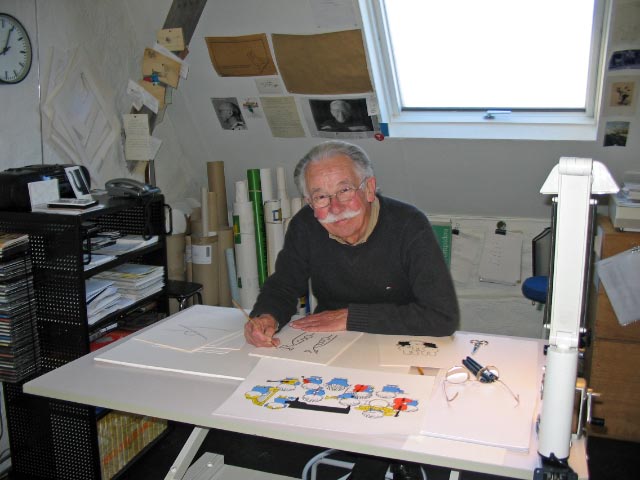
Dick Bruna’s story begins with a choice, a departure from a destined career in publishing, to forge his path in art and design. Born into the prestigious Dutch publishing family behind A.W. Bruna & Zoon, Dick Bruna was poised to take up the mantle. Yet, his heart led him elsewhere. His early forays into art, with stints in London and Paris, exposed him to the works of masters like Fernand Léger and Henri Matisse. It was these influences that helped to shape his distinctive style: bold lines, primary colours, and an almost deceptive simplicity that would become his signature.
Iconic Simplicity
Bruna’s most enduring creation, Miffy, embodies his design ethos. With heavy graphic lines and a limited colour palette, Miffy became an icon of children’s literature and design. But Bruna’s work was not confined to the page. His graphic design for book covers, posters, and promotional materials for his family’s publishing company carried the same distinctive style. His covers for the Zwarte Beertjes series are particularly notable for their use of stark silhouettes and vivid backgrounds, bringing an element of playful sophistication to the detective and thriller genres.
Influences and Inspirations
Bruna’s work can be seen as a dialogue with the art movements he admired. The stark contrasts and bold colours echo the Fauvist influences of Matisse, while the transparent, strong lines reflect the modernist sensibilities of Léger. His time in Paris, amidst the upheaval of post-war Europe, was not just an escape but a formative period where the seeds of his later style were sown.

Beyond Miffy
While Miffy remains Bruna’s most recognizable character, his oeuvre is vast. He illustrated over 2,000 covers and created more than 100 posters. His works extend beyond children’s books to include creations for characters like Lottie, Farmer John, and Hettie Hedgehog. Bruna’s designs often carried gentle humour, a softness that belied the sharpness of his lines.
Legacy and Recognition
Bruna’s contributions to design were recognized late in his career with accolades and exhibitions, such as the showing at the Rijksmuseum and the Max Velthuijs Award. The Dick Bruna Huis and the Nijntjemuseum further cement his place in the pantheon of great designers, offering a space where new generations can encounter his work.
Engaging with Bruna’s Work
As you delve into the world of Dick Bruna, consider the impact of minimalism in design. What can we learn from Bruna’s use of colour and line? How does the simplicity of his work speak to the complexity of conveying a story or a feeling? Share your thoughts and explore further on Encyclopedia Design.
Sources
Wikipedia contributors. (n.d.). Dick Bruna. Wikipedia. Retrieved from https://en.wikipedia.org/wiki/Dick_Bruna
Miffy’s official website. (n.d.). About Dick Bruna. Retrieved from https://www.miffy.com/about-dick-bruna
Famous Graphic Designers. (n.d.). Dick Bruna. Retrieved from https://www.famousgraphicdesigners.org/dick-bruna
Encyclopaedia Britannica. (n.d.). Dick Bruna. Britannica. Retrieved from https://www.britannica.com/biography/Dick-Bruna
More Graphic Designers

Bauhaus Posters: Graphic Design as Applied Art, Pedagogy, and Public Communication
Bauhaus posters symbolize modern graphic design’s evolution, merging art, architecture, and education. They prioritize clarity, structure, and ideology, impacting graphic communication and contemporary design significantly.
Keep reading
Luba Lukova: The Power of Visual Metaphor in Design
Luba Lukova, a New York-based artist from Bulgaria, creates impactful artwork addressing social issues like justice and freedom through minimalist design and visual storytelling.
Keep reading
Alvin Lustig: The Multifaceted Designer of Modernism
Alvin Lustig was a pioneering designer whose multidisciplinary work in graphic design, book covers, and interiors established enduring design principles, influencing contemporary aesthetics.
Keep reading
Swiss Graphic Design and its Impact on Decorative and Applied Arts
Swiss graphic design, rooted in principles like grid systems and minimalism, has profoundly influenced global aesthetics, blending functionality and artistic beauty across various media.
Keep reading
Pierre Gauchat: Pioneer of Swiss Graphic Design
Pierre Gauchat (1902–1956), a Swiss graphic designer, influenced 20th-century design with his clarity and functionality, notable for iconic posters, logos, and initiating design competitions.
Keep reading
Dafi Kühne: Master of Letterpress and Graphic Design
Dafi Kühne is a Swiss poster designer and educator known for blending contemporary design with traditional letterpress techniques, creating innovative works that inspire appreciation for craftsmanship.
Keep reading
Gordon Andrews: A Pioneer in Australian Design
Gordon Andrews, influential Australian designer known for diverse work, including banknote design, showcased international style amidst mid-20th century. Legacy continues to inspire.
Keep reading
Honoring Barbados Centenarians: A Unique Stamp Tribute
The Barbados Postal Service released “Centenarians of Barbados” stamps in 2016, honoring 27 individuals who reached 100 years or more, coinciding with the nation’s 50th Independence Anniversary.
Keep reading
Gerard Kiljan: Contributions to Dutch Modernist Design and Education
Gerard Kiljan, a Dutch modernist designer, integrated photographic techniques into dynamic “typo photo” works. His influence extended to teaching and functionalist design.
Keep reading
Jacob Jongert: Merging Artistry and Advertising in the Interwar Period
Jacob Jongert, an influential figure in applied arts, is best known for his innovative advertising designs at Van Nelle and his impact on modernist aesthetics. His legacy remains influential.
Keep readingRelated Articles

Discover more from Encyclopedia of Design
Subscribe to get the latest posts sent to your email.