This article forms part of the Decorative and Applied Arts Encyclopedia, a master reference hub providing a structured overview of design history, materials, movements, and practitioners.

Peter Behrens (1868 – 1940) was a German graphic artist, architect, and designer. He studied at Karlsruhe Düsseldorf, and Munich.

Professional Career
In 1893, he joined the avant-garde group associated with the Munich Secession. In 1896, he travelled in Italy in 1898 studied industrial mass production.
Following the lead of the Wiener Werkstätte, in 1897 (with Hermann Obrist, Bruno Paul, Bernhard Pankok, and Richard Riemerschmid) founded Vereinigte Werkstätten fur Kunst im Handwerk (United Workshops for Art in Hand-Work), aiming to sell everyday objects designed by Modern artists. Inspired by English models, he worked there as a painter and graphic designer.
Early Jugendstil designs were replaced by a Cubist and Rationalist style, as seen in his plans for the house in the Darmstadt artists’ colony of 1901 and the Pavilion of Decorative Arts at 1902 Turin ‘Esposizione Internazionale d’Arte Decorativa Moderna.

In 1899, the Grand Duke Louis IV of Hesse-Darmstadt included Behrens, forming the art colony at Darmstadt. His first building was his 1901 house in Darmstadt, where he had an opportunity to employ his abilities as an architect and designer of furniture, glass, ceramics, silver, and jewellery; in Darmstadt, he designed silver flatware in the Secession style made by M.J. Rückert and a desk set by Martin Mayer. Ornamentation disappeared on his silverWork, especially that Franz Bahner, Düsseldorf produced.
Bruckmann und Sohne, Heilbronn made other silverwares. Having left the artists’ colony, he lived in Düsseldorf, where he was director of the Kunstgewerbeschule 1904-07 (with Hermann Muthesius and others) and founded the Deutscher Werkbund (German Work Association).
AEG Turbine Factory
On the invitation of AEG managing director Walter Rathenau, they began to work in Berlin from 1908 on the corporate identity of the enormous German industrial combine, for which Behrens produced architecture, graphics, kettles, electric fans, and clocks, the first time a firm had hired an artist to advise on all facets of industrial design; designed the seminal 1908-09 AEG turbine factory and several other buildings for AEG. His style did not lend itself easily to canonisation; indeed, even the Turbine Factory is difficult to appreciate without understanding its historical context.

Summary of Work
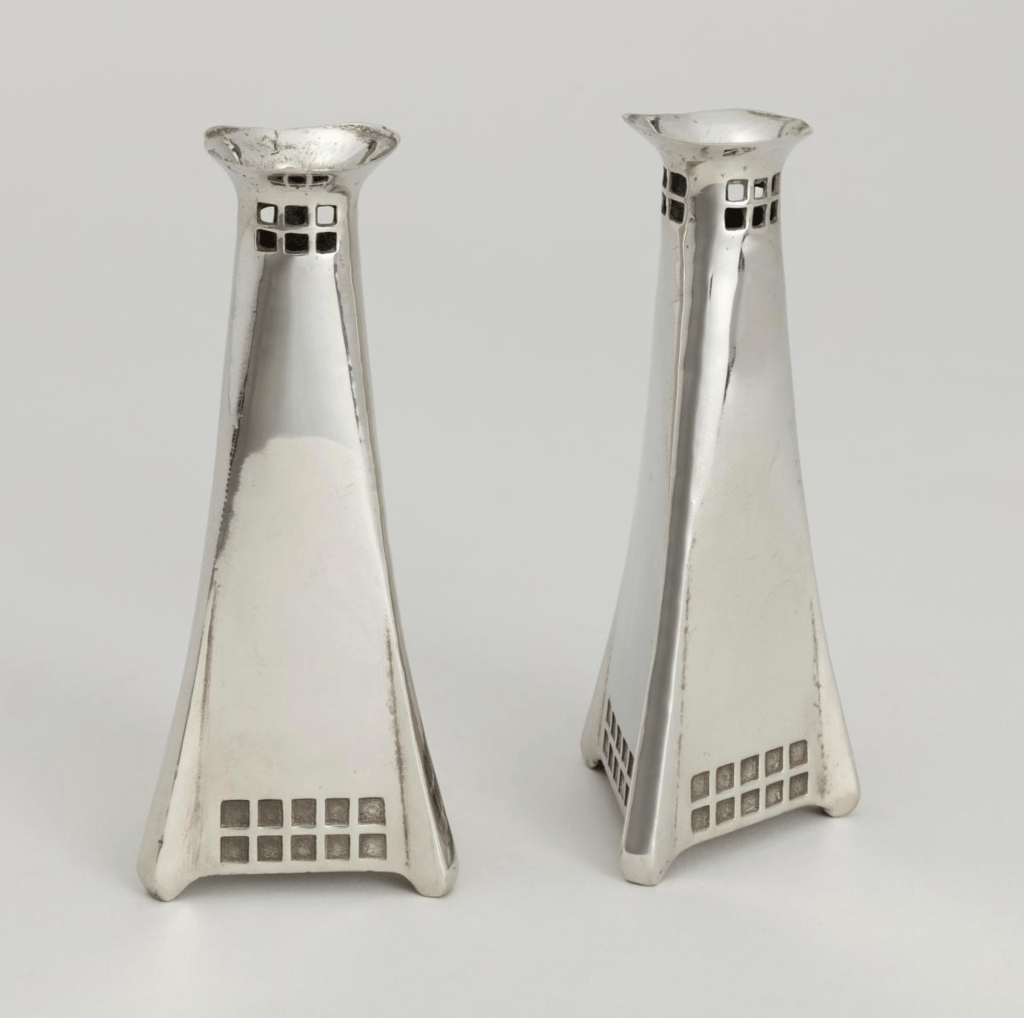


Some porcelain designs were produced by Manufaktur Mehlam Gebr, Bauscher, Weiden, Bonn, and Rhemische Glashtütten, Köln-Ehrenfeld glass designs. For a time in 1910, Le Corbusier (1910-11), Gropius (1907-10), and Mies van der Rohe (1908-11) worked side by side in Behrens’s office. In the 1910s, Behrens designed linoleum patterns for Delmenhorster Linoleum Fabrik, an early member of the Werkbund. From 1922, he was the director of both schools of architecture at Akademie der bildenden Künste, Vienna, and, from 1936, Preussische Akademie der Künste, Berlin. In 1926, he designed the house ‘New Ways,’ Northampton (England). In 1932, they collaborated with Ferdinand Wilm and others to form Gesellschaft für Goldschmiedekunst (Society for Gold-smiths’ Work).
Sources
Byars, M., & Riley, T. (2004). The design encyclopedia. Laurence King Publishing.
ArchDaily Website. (2020, April 14). Spotlight: Peter Behrens. ArchDaily. https://www.archdaily.com/619290/spotlight-peter-behrens.
More German Designers

Exploring Sustainable Design at the Institute for Lightweight Structures
The Institute for Lightweight Structures at the University of Stuttgart, founded by Frei Otto, advances lightweight architecture focusing on efficiency,…
Keep reading
Elegant Living with ILSE Furniture – The Essence of 1960s Modernism
ILSE Möbel, a notable 1960s German furniture manufacturer, combined quality craftsmanship and modernist design, creating iconic coffee tables and versatile…
Keep reading
Exploring Pforzheim: The Golden City’s Jewelry Heritage
Pforzheim, known as Germany’s “Golden City,” has a rich jewellery history, highlighted by Art Nouveau designs and the renowned Schmuckmuseum,…
Keep reading
Hermann Muthesius: Architect, Reformer, and Pioneer of Modern Design
Hermann Muthesius, a pivotal figure in modern architecture, introduced English Arts and Crafts principles to Germany, influencing Bauhaus and emphasizing…
Keep reading
Constantin Wortmann: A Visionary in Contemporary Design
Constantin Wortmann, a German designer, blends functionality and whimsy in his works at Büro für Form, creating emotionally resonant, visually…
Keep reading
German Expressionism and Its Impact on the Decorative Arts of the Early 20th Century
German Expressionism, a 20th-century movement, emphasized emotional depth, interdisciplinary integration, and urban life, influencing design through innovative materials and holistic…
Keep readingSomething went wrong. Please refresh the page and/or try again.
More design articles
Discover more from Encyclopedia of Design
Subscribe to get the latest posts sent to your email.